Conversion Optimization Consulting: Benchmarks & Specialists
Learn what conversion optimization consulting covers, real benchmarks by traffic stage, and whether your conversion rate or your traffic is the actual problem.
Read →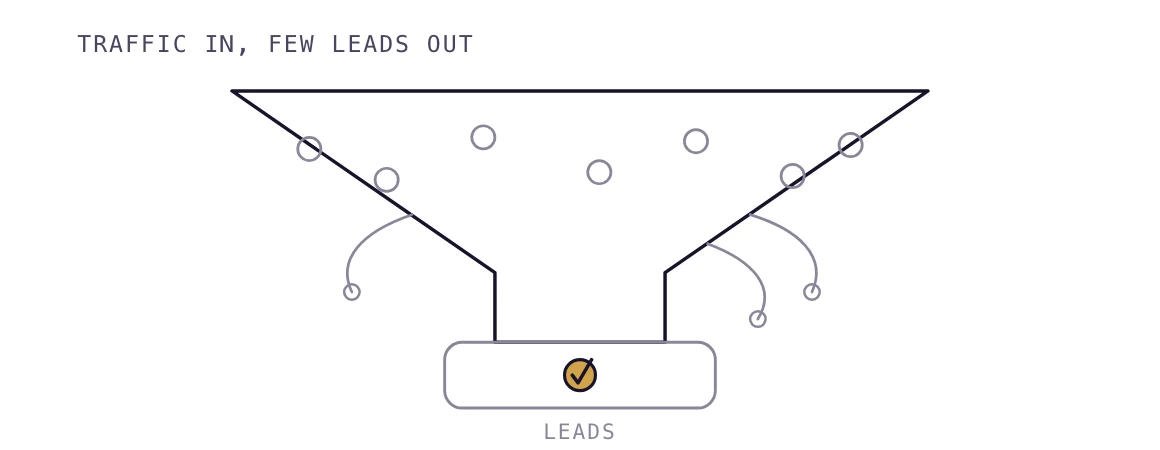
Does your blog get traffic but no leads? The gap usually traces back to five factors: unclear calls-to-action, mismatched search intent, missing trust signals, slow-loading pages, and content that never connects to a product. Fixing blog traffic but no leads starts with checking where readers stop scrolling and what happens the moment after that scroll stops.
The bigger problem isn't always low traffic. It's low-intent traffic.
Many times, your Search Console looks great. The graphs are going up, impressions are increasing, clicks are coming in, and rankings are improving. On paper, everything looks like it's working.
But then you look at revenue, and nothing has changed.
That's usually a sign that the wrong people are finding you. You might be ranking for keywords that bring traffic but have little connection to what you actually sell. You're getting visitors who are curious, researching, or looking for free information, but not people who are ready to become customers.
And that's why traffic alone can be a misleading SEO metric.
Getting 300 visitors who never buy isn't necessarily better than getting 30 visitors who are actively looking for what you sell. If 10 of those 30 are warm leads, that traffic is far more valuable to your business.
The goal isn't simply to get more people to your website. It's to get more of the right people to your website. That means targeting searches that match your audience, their problems, and their buying intent, rather than chasing traffic for the sake of a bigger graph.
Blog traffic but no leads means visitors arrive, read, and exit without submitting a form, booking a call, or starting a trial. Sessions climb while contacts stay flat. This differs from a low-traffic problem, because the issue here is conversion, not discovery.
However, generating leads still ranks as a top challenge for 30% of marketers in 2026, according to HubSpot's State of Marketing report (2026). Most blogs sit somewhere on this same gap between reach and revenue, because ranking for a keyword and answering the reader's actual next question are two different jobs.
Most blogs lose leads to five gaps: weak calls-to-action, keyword-intent mismatch, missing trust signals (this guide here discusses how to structure your content to get cited by AI search), slow pages, and content that never mentions the product. Each gap blocks a different point in the reader's decision path, so fixing only one rarely moves the needle. Also, these five overlap often, so a post can lose leads to two or three of them at the same time.
Before rewriting any CTA, check where visitors actually land with a traffic source breakdown. A mismatch between channel and offer is often the real cause, not the copy itself.
Pull the last 20 blog posts and count how many carry a CTA above the fold. Sites with traffic but weak leads usually find that number sits under 30%.
Five more issues quietly drain leads even when a blog ranks well: irrelevant lead magnets, long forms, no follow-up sequence, thin author trust, and content written for search engines instead of buyers. Because these five sit further down the funnel, they usually show up only after the first five gaps are already fixed.
PilotDeck treats trust signals as a ranking input, not decoration. Author credentials and original data both affect how content performs in AI search, not only in Google, since AI Overviews and chat assistants tend to favor pages that name a real author and cite a real source. If you are curious about how AI citation tracking works, this guide on how to track brand mentions in ChatGPT is an excellent place to start.
I've audited blogs ranking on page one for their target keyword with a 0.3% lead rate. The article was correct. The offer at the bottom asked for a demo call when the reader only wanted a checklist.
Turning blog traffic into leads means matching the CTA to the reader's stage, cutting form friction, and giving returning visitors a reason to act sooner. Returning visitors already trust the site, so they convert at nearly double the rate of first-time readers, 2.9% versus 1.7%, according to Contentsquare's 2026 Digital Experience Benchmark (March 2026). That gap means a returning-visitor nudge, such as a saved-progress email or a second, easier offer, often converts better than any change to the first-time CTA.
| Problem | Fix |
|---|---|
| No CTA | Add one CTA above the fold matching the article's intent |
| Wrong offer | Swap demo requests for content-stage offers like checklists or templates |
| Long forms | Cut fields down to name and email only |
| No follow-up | Trigger a reply email within 24 hours of submission |
| Slow pages | Compress images and defer non-critical scripts |
Also, teams that map every post to a content funnel stage see this fix compound across dozens of articles instead of just one.
Match one CTA per article to the exact question the post targets. Multi-offer pages split attention and lower every conversion metric on the page.
High traffic with low conversions across your website doesn't always mean something is broken. Often, it simply means you're attracting people who aren't ready to buy yet.
A blog post and a pricing page serve very different purposes. Someone reading a blog post might just be researching, while someone on your pricing page may already be considering a purchase. So when a blog post suddenly brings in thousands of visitors, you shouldn't expect your sales to jump at the same time.
That's why it's important to look at your traffic based on where people are in their buying journey. A blog post should be compared with other educational content, not with a page designed to generate demos or sales. Otherwise, good content can look like it's performing badly simply because it attracts people at an earlier stage.
PilotDeck's audits start by looking at traffic this way before recommending changes. Because when you look at every visitor the same way, it's easy to miss where the real problem is.
Scroll depth past 75%, time on page above two minutes, and CTA click rate predict lead generation better than pageviews or bounce rate alone. Pageviews measure reach; the other three measure intent to act. Also, a rising CTA click rate on an unchanged page usually means the audience shifted, not the copy.
For example, watching these three numbers move is how one ranking case study traced a jump in blog leads back to a single CTA change. Track them weekly, not monthly, since CTA click rate reacts to copy changes within days, while pageviews can stay flat for a month before a fix shows up.
Blog traffic without leads is rarely one broken thing. It is usually two or three small gaps stacking up: a missing CTA, a mismatched offer, and a form that asks for too much. Start with the post getting the most traffic and the fewest leads, fix one gap, then measure the next 30 days before touching a second post. Ranking well and converting well are separate skills, and most blogs only ever practice the first one.
Traffic without leads usually means the page answers the search query but never asks for the next step. Check for a visible CTA, a matching offer, and a short lead form before assuming the traffic itself is low quality.
Visitors leave without converting when the offer does not match why they searched, or when trust signals like author credentials and data are missing from the page. Slow load times push the same visitors out even sooner.
Add one clear CTA per post, cut forms to name and email, and follow up within 24 hours of a submission. Small friction fixes compounds across every published article once applied consistently.
Match each post's CTA to its search intent, then track scroll depth and CTA click rate weekly to see which articles are closest to converting. Fix the closest ones first.
A gap between acquisition channel and page intent is the most common cause. Traffic from a broad keyword rarely converts at the same rate as traffic from a buying-intent search, so blended averages can mislead.
The content informs without asking the reader to act. Add a CTA that matches the article's promise, and remove any friction between reading and submitting, starting with the highest-traffic post.

Learn what conversion optimization consulting covers, real benchmarks by traffic stage, and whether your conversion rate or your traffic is the actual problem.
Read →75 sourced statistics on how fast generative AI is spreading, what it costs, who uses it at work, and whether people trust it, with every figure labeled and linked to its source.
Read →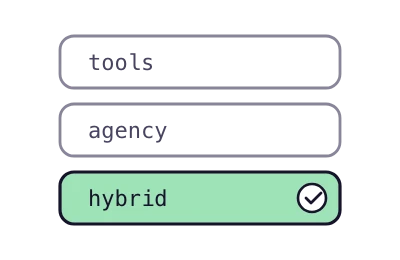
See what b2b seo services actually include, tools vs agencies vs hybrid, plus a month by month checklist, read on to find the right fit for your budget.
Read →Hand over a domain. Research runs and your first article is written within the hour.
Start free trialCancel any month. Your site and content stay yours.