Copilot vs ChatGPT: Is Copilot the Same as ChatGPT?
Compare Copilot vs ChatGPT and answer: Is Copilot the Same as ChatGPT? Learn the key differences in features, models, integrations, and use cases.
Read →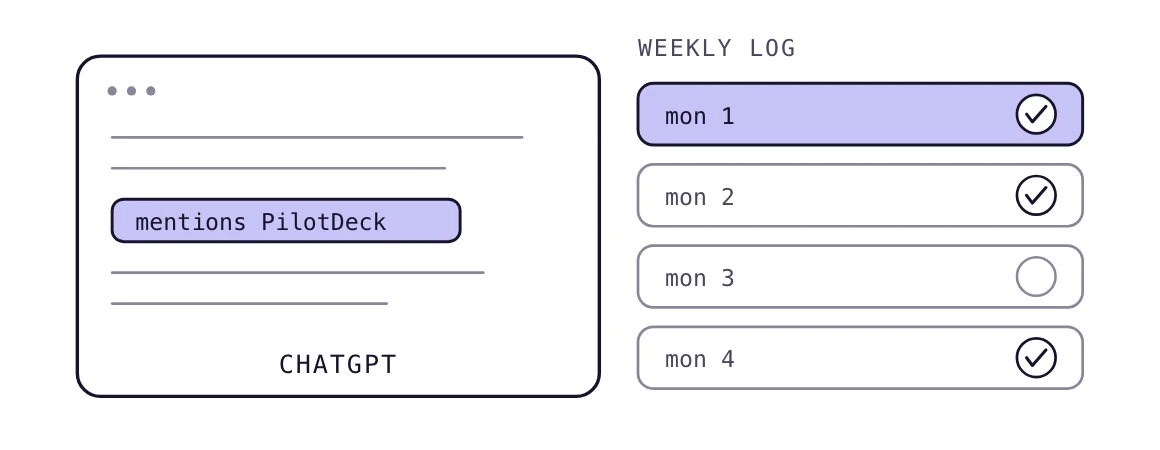
To track brand mentions in ChatGPT, run a consistent set of buyer-focused prompts on a fixed schedule and record whether your brand appears, where it appears, which competitors are mentioned, and what ChatGPT says about your brand. You can track a small number of prompts manually in a spreadsheet or use an AI visibility tool to automate monitoring, reporting, and trend analysis.
Brand mention tracking in ChatGPT is the practice of monitoring how often, and in what context, ChatGPT's answers reference your company, product, or founder by name. It covers direct mentions, comparison mentions against named competitors, and citations of your own content as a source.
A ChatGPT brand tracker monitors how often and where your brand appears in ChatGPT responses for a consistent set of prompts. Depending on the tool, you can track brand mentions, competitor mentions, ranking position, share of voice, sentiment, and citations over time.
A useful tracker should monitor more than whether ChatGPT mentions your brand. It should show how your visibility changes across prompts and how your brand compares with competitors.
| Metric | What it tells you |
|---|---|
| Brand mention rate | How often ChatGPT mentions your brand |
| Mention position | Where your brand appears in the response |
| Competitor mentions | Which competitors appear alongside or instead of your brand |
| Share of voice | Your visibility compared with competing brands |
| Sentiment | How ChatGPT describes your brand |
| Citations | Whether your website or content is referenced |
| Visibility over time | Whether your ChatGPT presence is increasing or declining |
You track brand mentions in ChatGPT because a growing share of buyers now research inside a chat window instead of a search results page. A February 2026 estimate put ChatGPT at 900 million weekly active users, highlighting the scale of the platform for brands to monitor.
So if ChatGPT never names your brand in relevant answers, you lose visibility at the exact moment someone is deciding what to buy. Also, competitors who do appear gain trust by default, since a user tends to treat the answer as a recommendation rather than an ad.
For the wider shift this fits into, see our guide to AI search visibility, which covers how ranking works once AI answers sit above the results page.
You check manually by opening ChatGPT and running the exact questions a buyer would ask, then reading whether your brand appears, where it ranks, and what claims get made about it.
Done this way, checking manually takes about 15–20 minutes a week — the hard part isn't doing it once, it's monitoring ChatGPT brand mentions easily enough that you actually keep the habit going.
Tools like PilotDeck automate this repeat-and-log cycle instead of leaving it to memory and an open spreadsheet tab.
I run the same 15 prompts every Monday before I touch anything else on a client account. The pattern only becomes obvious after four or five weeks, never after one. — Alpesh D., Co-founder, PilotDeck
Yes, dedicated AI visibility tools exist that automate the prompt-run-and-log process instead of you doing it inside ChatGPT's own interface. These platforms are sometimes called a ChatGPT brand tracker or mention tracker - the label varies, but the job is the same: query, log, and report on a schedule. A ChatGPT visibility tracker can automate this process by monitoring brand mentions, positions, competitors, and citations over time.
The best ChatGPT brand monitoring tool depends on how many prompts you need to track and whether you want to monitor only ChatGPT or multiple AI search platforms. Look for tools that support scheduled prompt monitoring, brand and competitor mentions, share-of-voice reporting, citation tracking, and historical visibility data.
For a small number of prompts, manual checks may be enough. For agencies and brands monitoring dozens or hundreds of prompts, an AI visibility platform can automate monitoring and show how brand visibility changes over time.
When comparing ChatGPT brand monitoring tools, consider:
Our AI visibility tools roundup compares the leading platforms if you want to test a few before choosing one.
| Tracking Method | Setup Time | Best For |
|---|---|---|
| Manual prompting in ChatGPT | None | Testing a handful of prompts |
| Spreadsheet with scheduled prompts | A few hours | Small teams checking monthly |
| Managed AI visibility tracking | Minutes | Ongoing tracking across many prompts |
| API-based tracking | Technical setup | Custom monitoring and reporting |
Test any tool on five prompts you already know the answer to before trusting its dashboard on the other ninety-five.
You monitor visibility over time — track your brand's performance in ChatGPT responses over time — by watching three numbers on a fixed schedule: mention rate, average position, and share of voice.
So a single strong week means little on its own. About 43% of U.S. online shoppers used an AI assistant for product research in the past 90 days, per a 2026 MarTech report, which is why a 90-day trend is more useful than relying on a single week's results.
For a closer look at how citations get counted across platforms, our citation analysis tools comparison walks through the methodology each tool uses.
| Metric | What to Track |
|---|---|
| Brand Mention | Whether your brand appears in the answer |
| Position | Where your brand appears in the response |
| Competitor Mentions | Which competing brands appear |
| Share of Voice | How often your brand appears compared with competitors |
| Sentiment | How ChatGPT describes your brand |
| Citation/Source | Whether your website or content is referenced |
| Prompt | The exact question used for testing |
| Date Checked | When the response was recorded |
The most useful ChatGPT brand-monitoring metrics are mention rate, average position, share of voice, competitor mentions, sentiment, and citation rate. Together, these metrics show not only whether ChatGPT mentions your brand, but also how prominently it appears compared with competitors.
For example, a growing mention rate can indicate stronger visibility, while a declining average position may mean competitors are becoming more prominent for the same prompts. Citation tracking can also show whether ChatGPT is increasingly using your website as a source.
If tracking competitor mentions in ChatGPT is your main goal rather than just your own visibility, log every brand named alongside yours on each prompt run, not only whether you show up — that's what actually reveals share of voice.
Yes, through an API-based workflow that sends standardized prompts to an AI model on a fixed schedule and logs the responses for analysis over time.
Because nearly 49% of active AI users say they would try a different brand if ChatGPT suggested one, according to a March 2026 EMARKETER and Publicis Commerce report, automatic tracking catches the moment a competitor takes your spot before a full quarter passes.
PilotDeck runs this check as part of its monthly AI visibility work, so a lost mention shows up the week it happens rather than the week you notice a sales dip.
Worth noting: even automated tools rarely track in true real time. ChatGPT doesn't expose a live mentions feed, so most platforms — PilotDeck included — run and log prompts on a set schedule (daily or weekly) rather than continuously. Daily checks are currently the closest thing to real-time brand mentions in ChatGPT you'll get.
The most common mistake is testing only your own brand name instead of the buyer questions that would surface naturally, which inflates how visible you think you actually are.
If mention tracking raises the bigger question of how AI answers differ from classic rankings, our GEO vs AEO comparison breaks down the distinction in plain terms.
Comparing this week's mention count to last week's without controlling for prompt wording will make normal variance look like a crisis.
"Most founders check ChatGPT once, see nothing, and quit. The brands that show up later are the ones who kept a spreadsheet."
There's no dashboard inside ChatGPT that hands you this for free. The founders who show up in AI answers six months from now are the ones running the same prompts today, on a fixed schedule, and reading the trend instead of trusting memory.
Run a fixed list of buyer-style prompts in ChatGPT on a repeating schedule, then log whether your brand appears, its position, and what is said about it. Manual spreadsheets work for a handful of prompts; a monitoring tool works better once the list grows.
Yes. ChatGPT does not provide a dedicated brand-mention monitoring dashboard, but you can monitor mentions by running repeat prompts yourself or by using a third-party AI visibility platform that automates the process on a schedule.
Open a fresh ChatGPT chat with memory off, ask a question your buyer would actually ask, and read the full answer for your brand name, your product, or a link to your site.
Yes. Dedicated AI visibility platforms query ChatGPT and other AI assistants on a schedule and report mention rate, ranking position, and sentiment, which removes the need to run prompts by hand.
Track mention rate, average position, and share of voice against named competitors on a fixed cadence, then judge the trend over 90 days rather than any single answer.
Because hundreds of millions of people now research inside ChatGPT before they ever reach a website, so a brand that never appears in relevant answers loses visibility at the exact moment a buyer is deciding.
Track mention rate, average position, share of voice, competitor mentions, sentiment, and whether ChatGPT references your website or other content.

Co-founder, PilotDeck
Alpesh builds the growth engine behind PilotDeck. He has spent years helping startups go from zero traffic to steady organic growth, and now brings SEO, GEO, AI automation and content strategy together in one repeatable system that also gets brands named in AI answers.
Compare Copilot vs ChatGPT and answer: Is Copilot the Same as ChatGPT? Learn the key differences in features, models, integrations, and use cases.
Read →
Compare 5 AI brand monitoring tools to track brand mentions, citations, and visibility across ChatGPT, Gemini, Perplexity, Claude, and other LLMs.
Read →
AI keyword research surfaces the conversational questions people ask ChatGPT and AI Overviews, while traditional keyword research still owns verified search volume. Here's how each works, where each still wins, and how to combine both without wasting your content budget.
Read →Hand over a domain. Research runs and your first article is written within the hour.
Start free trialCancel any month. Your site and content stay yours.