75+ Generative AI Statistics You Need to Know in 2026
75 sourced statistics on how fast generative AI is spreading, what it costs, who uses it at work, and whether people trust it, with every figure labeled and linked to its source.
Read →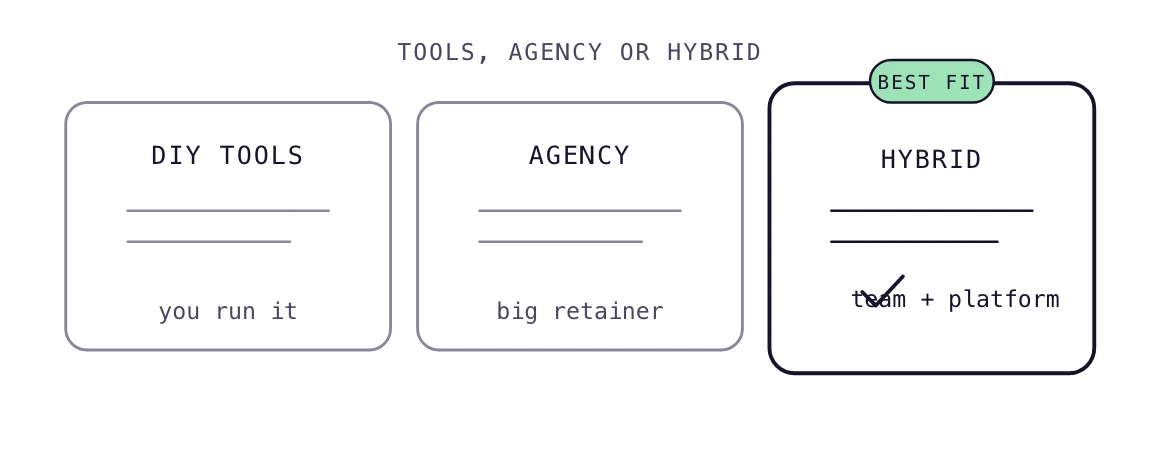
B2B SEO services help businesses attract potential customers through search by combining keyword research, technical SEO, content strategy, and performance measurement. Depending on the provider, they may also include link building, content distribution, and work to improve visibility in AI-powered search experiences. The right approach depends on your team's capabilities, budget, competition, and how much of the work you want to outsource.
Getting traffic to a B2B website isn't just about ranking for a few keywords. You need to reach people who might actually buy what you sell, answer the questions they're asking, and give them a reason to consider your business over the alternatives.
That's where B2B SEO services come in. But what should you actually expect from a provider? And do you need a full-service agency, a few SEO tools, or something in between? Let's look at what each option offers and how to choose.
B2B SEO services typically cover four core areas:
The exact scope varies by provider. Some focus mainly on strategy and recommendations, while others handle implementation, content production, outreach, reporting, and ongoing optimization. Before signing a contract, find out which activities are actually included and which require additional fees or your team's involvement.
Some providers also offer GEO (generative engine optimization) or AEO (answer engine optimization) as part of their services. These terms generally refer to efforts to improve a brand's visibility in AI-powered search and answer experiences. The work can overlap substantially with traditional SEO, including making content useful, keeping information accurate, and ensuring important pages can be discovered and understood.
It's worth distinguishing a service from a tool, too. A service typically provides expertise and execution, while a tool helps you research, monitor, or automate parts of the process. Some offerings combine the two, but the amount of human involvement can vary considerably.
SEO for B2B marketing deals with longer sales cycles and multiple decision-makers, unlike B2C where one person can buy on impulse. A single enterprise purchase might involve a buyer, a finance approver, and a technical evaluator, each searching different terms at different stages. SEO for B2B has to account for all three.
This means SEO B2B marketing content can't just chase top-of-funnel traffic. A blog post that ranks for "what is X" won't convert a finance approver comparing vendors. Content has to exist for each stage of that committee's research, from problem awareness to vendor comparison to implementation questions.
Content built for consideration beats content built for clicks. B2B buyers spend weeks or months researching before they talk to sales, so the content that earns trust during that window often matters more than the content that first attracts them.
Keyword intent in B2B skews commercial and mid-funnel rather than purely informational, because searchers are already evaluating solutions, not just learning terms.
A self-serve tool is enough when you have the time to act on recommendations and just need visibility into what's broken. B2B SEO tools handle keyword tracking, technical audits, and competitor analysis, but someone still has to write the content and fix the code.
A full agency makes sense when you have budget for a dedicated team and want someone else to own strategy, writing, and outreach end to end. The tradeoff is cost and speed: agencies typically require longer contracts and slower ramp-up before results show, and many are built to serve any B2B company regardless of how the site was built.
If a b2b growth marketing agency can't explain how it would handle a site built on Lovable, v0, or Framer differently from a traditional CMS site, ask what their technical SEO process actually touches.
For businesses that need more than a dashboard but don't want to outsource everything to a traditional agency, a hybrid service may be worth considering. The combination of automated SEO workflows, ongoing content production, and human expertise can help teams maintain consistent activity without managing every task themselves.
PilotDeck is one option in this category, combining AI-powered SEO workflows with content strategy, human review, and AI search visibility tracking. Whether it is the right fit depends on the amount of execution and strategic support your business needs.
| Option | Best for | Ownership of work | Typical commitment |
|---|---|---|---|
| Tool only | Teams with time to execute themselves | You | Monthly, cancel anytime |
| Full agency | Larger budgets wanting full delegation | Agency team | Multi-month contract |
| Hybrid service | Teams needing a combination of software, content execution, and expert input | Shared, service-led | Flexible, product-led |
A B2B content marketing strategy maps content to each funnel stage instead of publishing posts at random. Top-of-funnel content targets broad awareness terms, mid-funnel content compares solutions, and bottom-funnel content answers objections right before a purchase decision.
A strong B2B marketing content strategy also aligns what you publish with how you distribute it. A blog post alone rarely reaches a buyer; it needs to show up where that buyer already spends time researching.
Content that's repurposed across social channels and paired with custom visuals tends to get cited more often by AI engines summarizing a topic, because it appears in more places with consistent framing.
Social distribution and AI image generation support this by turning one piece of core content into multiple formats: a LinkedIn post, a visual summary, a short explainer graphic. Social Media Distribution extends reach without requiring a separate content calendar, and AI Image Generation replaces generic stock photos with visuals built specifically for the topic.
Compare the tradeoffs in AI images versus stock photos if you're deciding how to source visuals for a content funnel. For a deeper look at structuring content by funnel stage, see this BOFU-first content funnel strategy.
B2B SEO strategies work best when sequenced instead of attempted all at once. Here's a practical seo strategy for b2b in the first three months:
Month 1-3 priorities:
A sound B2B seo strategy doesn't stop at month three. Ongoing measurement matters as much as the initial setup, and that now includes tracking visibility inside AI answer engines, not just traditional rankings.
An AI SEO Visibility Tool that tracks whether your brand gets cited in AI-generated answers gives you a metric traditional rank trackers miss entirely.
Ongoing measurement checklist:
Keeping content in a scannable checklist format also helps AI Overviews and answer engines extract and cite your steps directly, which reinforces the GEO/AEO work done earlier in the process.
If you're weighing whether a tool, an agency, or a hybrid service fits your stage, talk to PilotDeck's SEO and AI experts about where your AI-built site stands today.
Pricing depends heavily on scope, whether you need a full agency team, a self-serve tool, or a hybrid service, and how competitive your market is. Compare offerings by what's included (content, technical work, GEO/AEO) rather than price alone before committing to a plan.
Yes, though the channel has expanded beyond traditional search results to include AI answer engines and chat assistants. Businesses that optimize for both traditional rankings and GEO/AEO visibility reach buyers at more points in their research process than those focused on search alone.
Agency pricing varies by scope and team size, and most require multi-month contracts rather than month-to-month flexibility. For a related breakdown of agency pricing structures, see how social media marketing agencies charge.
The rule of 7 is a marketing principle suggesting a prospect needs roughly seven touchpoints with a brand before they're ready to buy. In B2B SEO, this translates to content spread across blog posts, social distribution, and search results touching the same buyer committee multiple times.
75 sourced statistics on how fast generative AI is spreading, what it costs, who uses it at work, and whether people trust it, with every figure labeled and linked to its source.
Read →
Compare digital marketing agencies for startups, SEO-only vendors, and AI-native visibility partners to decide what fits your launch stage.
Read →
What a saas content marketing agency does for AI-built sites, how to pick one, and where GEO/AEO fits. A practical buying guide for founders.
Read →Hand over a domain. Research runs and your first article is written within the hour.
Start free trialCancel any month. Your site and content stay yours.