75+ Generative AI Statistics You Need to Know in 2026
75 sourced statistics on how fast generative AI is spreading, what it costs, who uses it at work, and whether people trust it, with every figure labeled and linked to its source.
Read →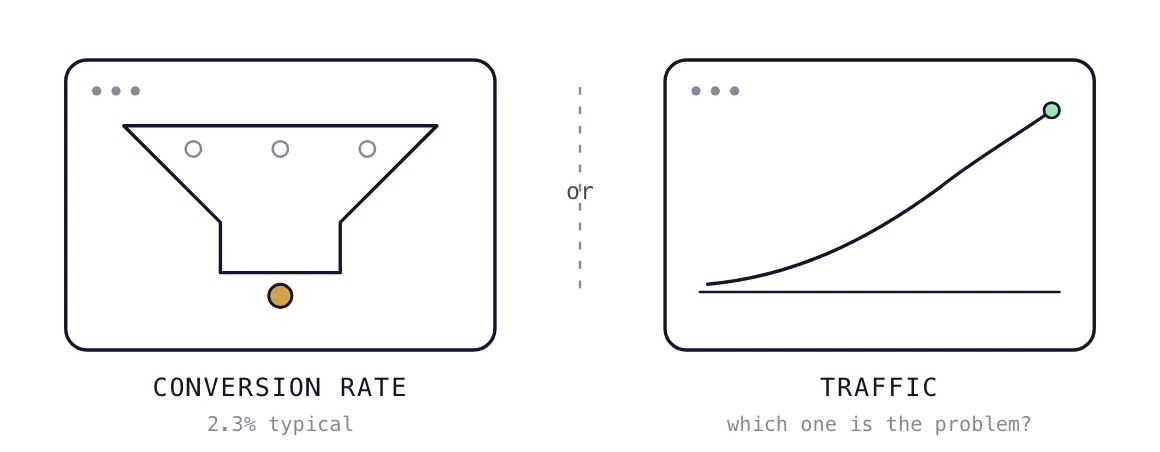
> Quick Answer: Conversion optimization consulting helps businesses turn more website visitors into customers through testing, analytics review, and page changes. Before hiring one, compare your conversion rate to real benchmarks by context since many "low" rates are actually normal, and the real problem is often traffic volume, not conversion.
Your website gets visitors, but sales aren't where you'd like them to be. Maybe the landing page isn't convincing enough. Maybe people are abandoning their carts or leaving without filling out your contact form. Or maybe you can't quite figure out where things are going wrong.
That's where conversion optimization consulting comes in. A specialist looks at how visitors use your website and identifies changes that could turn more of them into customers. But before you spend money on improving conversions, there's a question worth asking: are enough people visiting your website in the first place?
If traffic is the problem, improving your conversion rate won't do much to fix your sales numbers. And that changes what you should spend your money on first.
Conversion optimization consulting is a paid service where a specialist audits your website's funnel, identifies where visitors drop off, and recommends or runs tests to increase the percentage who complete a goal action. That goal could be a purchase, a form submission, or a demo booking.
Consultants typically work from analytics data (heatmaps, session recordings, funnel reports) rather than guesswork. They form hypotheses, run A/B tests, and measure lift against a baseline conversion rate.
CRO consultants are most useful when a website already attracts meaningful traffic but isn't converting those visitors into customers as expected. A site getting 50 visitors a month rarely has enough data for conversion testing to produce reliable results, no matter how skilled the consultant is.
> Worth Knowing: Most CRO testing methods need a few hundred conversions per variant before results are statistically reliable, which is why consultants often ask for traffic numbers before taking on a project.
A CRO report is a document that summarizes a website's conversion performance, identifies friction points in the funnel, and lists prioritized recommendations for improvement.
It typically contains:
Businesses commission a CRO report before committing to a full consulting engagement, treating it as a diagnostic step. Agencies also use these reports internally to justify which tests to run first, since testing budget and traffic are both limited resources.
A conversion rate optimizer is a person or role focused specifically on increasing the percentage of website visitors who complete a desired action, distinct from a tool with the same name.
The term gets used two ways. As a role, it describes a specialist (in-house or consultant) who owns testing and funnel analysis. As a tool category, "conversion rate optimizer" sometimes refers to software that runs A/B tests or personalizes page content automatically.
The human role focuses on:
A tool can execute tests, but it cannot decide what's worth testing or why a page is underperforming. That judgment is the consultant's actual value.
An optimization specialist is a marketer whose focus narrows to a specific conversion lever, such as landing pages, checkout flow, or email capture, rather than marketing generally.
This differs from a generalist marketer, who might split time across SEO, paid ads, email, and social without going deep on any single funnel stage. An optimization specialist spends most of their time on one thing: making an existing traffic source convert better.
A business needs this role when it already has stable, repeatable traffic (from ads, organic search, or referrals) but revenue isn't scaling with visits. If traffic itself is inconsistent or low, an optimization specialist has little to work with, since testing requires volume.
Whether a conversion rate is "good" depends entirely on what's being measured, website type, traffic source, and sales model all change the baseline. A 2.5% rate might be strong for a cold-traffic ecommerce store and weak for a high-intent B2B landing page.
| Conversion Rate | Typical Context |
|---|---|
| 0.7% | Low for most sites; common on cold or unqualified traffic, paid social, or very early-stage funnels |
| 2.5% | Reasonable average for many ecommerce and general lead-gen sites |
| 10% | Strong performance, often seen on high-intent traffic like branded search or returning visitors |
| 12% | Very strong, typically tied to a well-qualified audience or a simple, low-commitment action |
| 30% | Exceptional and usually reflects a narrow funnel step (e.g., email signup) rather than full-site conversion to purchase |
> Red Flag: Comparing a full-site conversion rate to a single-step rate (like "added to cart" or "email submitted") produces misleading benchmarks. Always confirm which stage of the funnel a number describes before judging it.
Etsy conversion rates vary by product category, price point, and traffic source, so comparing a shop directly with a general ecommerce benchmark can be misleading. Etsy's seller guidance gives 1–5% as a general reference range for its sellers, while emphasizing that a good rate depends on the individual shop.
A good ecommerce store conversion rate generally sits in a similar range to the site-wide benchmarks above, with the caveat that paid traffic converts lower than organic or email traffic, and mobile traffic typically converts lower than desktop.
Making $10,000 a month on Etsy is achievable but depends entirely on traffic volume, average order value, and conversion rate together, not on any one metric alone. A shop with a 2% conversion rate and a $25 average order needs roughly 20,000 monthly visitors to hit that revenue figure; a shop with a higher average order value needs far less traffic to reach the same number.
> Worth Paying Extra For: A consultant who builds a simple traffic-times-conversion-times-order-value model for your specific numbers, rather than quoting a generic industry average, gives you a target you can actually plan around.
CRO consulting is the right move when you already have steady traffic and a conversion rate that's clearly below the benchmark for your funnel type. Fixing traffic first is the right move when your visitor count is too low for any test to reach significance.
Signals that traffic, not conversion, is the real problem:
Signals that CRO consulting is the right next step:
> Buying Tip: Pull your last 90 days of traffic by source before calling a CRO consultant. If organic search traffic is near zero, that's the gap worth closing first.
The right consultant asks for your traffic and conversion data before quoting a plan, rather than pitching a package upfront. Look for:
Red flags to avoid:
Fit matters more than agency size. A consultant used to enterprise retainers may design a testing plan that requires more traffic than your website currently gets. Ask directly: "At my current traffic, how long until a test reaches significance?" A straight answer to that question tells you more than any portfolio.
If the numbers point to a traffic problem rather than a conversion problem, focus on getting more qualified visitors to your website first. Organic search can be one way to build that traffic over time. Once you have enough consistent visitors, you'll have a better basis for deciding whether conversion optimization is worth the investment.
The right alternative depends on what you need help with. If your conversion rate is reasonable but traffic is low, an SEO and content-focused service may be a better fit than a CRO agency. If you already have steady traffic but visitors aren't converting, look for a consultant who specializes in conversion testing and funnel analysis.
Yes, 12% is a strong conversion rate for most funnels. It's typically seen on well-qualified traffic, such as branded search visitors or returning customers, rather than cold or paid traffic, which usually converts at a lower rate.
Yes, 10% is considered strong performance for most site-wide funnels. It generally reflects high-intent traffic, such as visitors who already searched for your specific product or brand, rather than broad top-of-funnel visitors.
A good ecommerce conversion rate generally falls in the same range as site-wide benchmarks, with paid traffic typically converting lower than organic or email traffic. Compare your rate against your own traffic source mix rather than a single flat number.
75 sourced statistics on how fast generative AI is spreading, what it costs, who uses it at work, and whether people trust it, with every figure labeled and linked to its source.
Read →
See what b2b seo services actually include, tools vs agencies vs hybrid, plus a month by month checklist, read on to find the right fit for your budget.
Read →
Compare digital marketing agencies for startups, SEO-only vendors, and AI-native visibility partners to decide what fits your launch stage.
Read →Hand over a domain. Research runs and your first article is written within the hour.
Start free trialCancel any month. Your site and content stay yours.