Copilot vs ChatGPT: Is Copilot the Same as ChatGPT?
Compare Copilot vs ChatGPT and answer: Is Copilot the Same as ChatGPT? Learn the key differences in features, models, integrations, and use cases.
Read →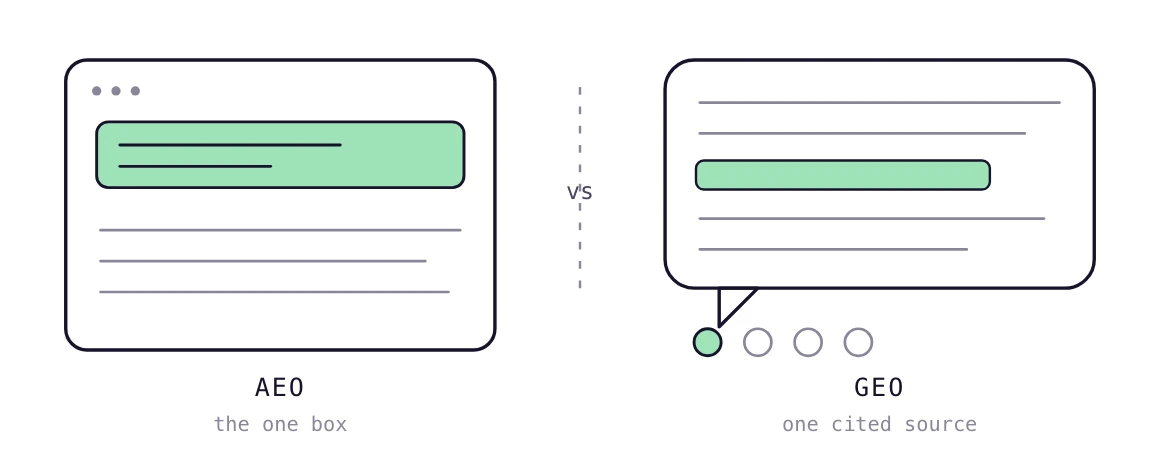
Short version: AEO (Answer Engine Optimization) is about being the single answer a machine reads back to someone, the featured snippet, the voice-assistant reply, the box that sits on top of Google. GEO (Generative Engine Optimization) is about getting your brand named and cited inside the longer answers that AI tools like ChatGPT, Perplexity, and Gemini write from scratch.
Same goal, different machines. AEO fights for the one-line answer. GEO fights for a mention in the paragraph. And if that distinction already feels a little blurry to you, good. You're paying attention. Plenty of people use these two acronyms interchangeably, and honestly, they're not entirely wrong to.
AEO isn't new. We were doing it years before anyone said 'generative AI' out loud. Think back to when Google started pulling a paragraph off a page and dropping it at the very top of the results, the featured snippet. Or when you asked Siri something and it read one answer back to you. That's the world AEO was built for.
The idea is simple. For a lot of questions, there's one best answer, and whoever owns that answer wins the moment. So you write content that hands it over cleanly: clear question, clear answer, right near the top. You add FAQ sections. You use schema so machines know exactly what they're looking at. You keep the answer tight, because 40 to 60 words tends to be the sweet spot for a snippet. None of it is glamorous work. It just works.
GEO is the newer cousin. Instead of one box with one answer, you've got ChatGPT writing a six-paragraph reply, or Perplexity stitching five sources into a single response. GEO is the work of making sure your brand is one of those sources, quoted, linked, or simply named.
The mechanics overlap with AEO more than the marketing likes to admit. You still need clear, factual, quotable claims. What changes is the target. You're optimizing for trust and citation across a whole answer, not a single snippet slot. AI models lean on sources they 'trust,' which in plain terms means content that's well structured, says the same thing consistently across the web, and carries some authority behind it. You're not gaming a ranking here. You're trying to become a reference.
Here's how I'd explain it to a founder over coffee.
The machine: AEO targets answer engines, Google's snippet, voice assistants, the 'People Also Ask' box. GEO targets generative engines, ChatGPT, Claude, Perplexity, Gemini, and Google's AI Overviews.
The prize: AEO wants to be the one answer. GEO wants to be one of the cited sources inside a longer answer.
The format: AEO rewards short, self-contained answers and tidy schema. GEO rewards depth, consistency, and being quotable across a full response.
The age: AEO has been around since featured snippets. GEO arrived with the LLM boom and is still being figured out in real time.
And here's the honest bit: the line between them keeps moving. Google's AI Overviews are part snippet, part generative answer, which is exactly why arguing about the acronyms matters less than doing the work both of them reward.
This is the question most people are really asking. Which one gets my name out there?
If I had to start with one, I'd lean GEO, and not because it's the shinier toy. AEO often gives the answer without the click or the credit. Google reads your snippet aloud and the person never learns it came from you. GEO, when it lands, names you. 'According to PilotDeck...' is worth a lot more than an anonymous box at the top of a results page.
But treating it as 'pick one' is the trap. The same clear, well-structured, factual content earns you both. Write it once, properly, and you can show up in the snippet and inside the AI answer off the same page. Which is the whole point of the next section.
You don't. And anyone selling you 'GEO services' as something completely separate from 'AEO services' is mostly selling you acronyms.
Underneath, both come down to the same handful of habits. Answer real questions directly. Structure your content so a machine can parse it without guessing. Back your claims with specifics instead of fluff. Stay consistent everywhere your brand shows up. And earn enough authority that you get trusted as a source. Do that, and you're optimized for the snippet, the voice answer, and the ChatGPT citation at the same time. The acronyms are just different doors into the same room.
This is the part we actually do for people. Every post we write is built two ways at once: tight enough to answer a specific question and win a snippet, and quotable enough for an AI tool to cite. We add the schema and the FAQ structure. We drop an llms.txt file on every site so AI models know what your business is about. Then we track both sides, your Google rankings and whether AI tools are naming you when someone asks about your space.
We don't sell GEO and AEO as two separate line items, because they aren't. It's one job: making sure that when a person, or a machine, goes looking for an answer in your corner of the internet, your name is in it.
Want your brand named in the snippet AND the AI answer? That's the job we do. See how PilotDeck handles it.
GEO and AEO aren't competing strategies. They're two doors into the same room. The content that earns a featured snippet is the same content an AI tool wants to cite: direct, structured, specific, and consistent everywhere your brand shows up. Stop shopping for acronyms and start writing the kind of page both machines reward.

Co-founder, PilotDeck
Alpesh builds the growth engine behind PilotDeck. He has spent years helping startups go from zero traffic to steady organic growth, and now brings SEO, GEO, AI automation and content strategy together in one repeatable system that also gets brands named in AI answers.
Compare Copilot vs ChatGPT and answer: Is Copilot the Same as ChatGPT? Learn the key differences in features, models, integrations, and use cases.
Read →
Compare 5 AI brand monitoring tools to track brand mentions, citations, and visibility across ChatGPT, Gemini, Perplexity, Claude, and other LLMs.
Read →
AI keyword research surfaces the conversational questions people ask ChatGPT and AI Overviews, while traditional keyword research still owns verified search volume. Here's how each works, where each still wins, and how to combine both without wasting your content budget.
Read →Hand over a domain. Research runs and your first article is written within the hour.
Start free trialCancel any month. Your site and content stay yours.