Content Marketing as a Service: What's Included and What It Costs
Content marketing as a service explained: what's included each month, how it differs from SEO alone, who needs it, how and what agencies charge
Read →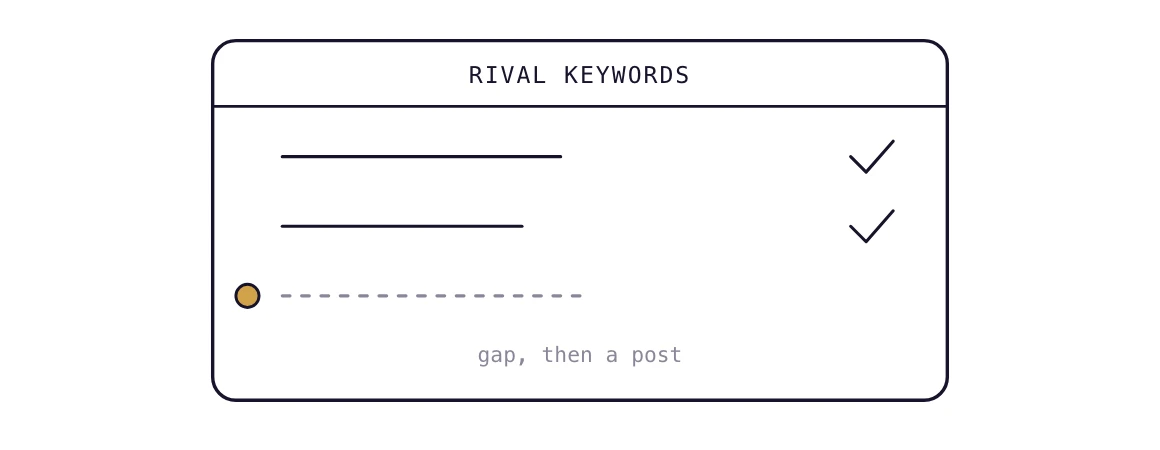
Competitive keyword research means studying what competitors rank for, where the gaps are, and which searches are close to a buying decision, then publishing content against it. Done once, it goes stale within months. Done monthly and tied to publishing, it keeps finding what's winnable as your site's authority changes.
A keyword spreadsheet from six months ago is already wrong. Competitors publish new pages, Google reshuffles rankings, and AI answer engines start quoting different sites. If your keyword research sits in a document instead of feeding monthly content, you're working off outdated data without knowing it.
Competitive keyword research is the process of identifying what your competitors rank for, where your site has gaps, and which of those gaps are actually worth chasing. It's not just pulling a list of high-volume terms. It's comparing your site's current position against specific competitors and deciding what's realistically winnable right now.
A term you can't rank for today might be open in three months once you've published more supporting content. PilotDeck treats this as an ongoing input, not a one-time deliverable: the research happens before anything is written, and runs again every month.
Our content engine pulls from four sources: competitor gap analysis, community conversation mining, SERP analysis, and seed keyword expansion. Each source surfaces different opportunities, and together they produce a prioritized list scored by potential ROI rather than raw search volume.
Keyword research and competitive analysis aren't two separate tasks. They're one process where competitor data decides which keywords matter at all. Without the competitive layer, you're just guessing at volume and difficulty scores with no sense of what's actually achievable for your specific site.
Gap analysis is the core mechanic: you compare your ranking pages against a competitor's, and flag the terms they rank for that you don't. That's different from simply listing keywords with decent search volume, because a term with 2,000 monthly searches means nothing if three entrenched competitors already own page one.
This changes priority, not just the list itself. A 200-search term with no competitor coverage can outrank a 2,000-search term where you're the fourth site trying to break in. Competitive analysis is what tells you which is which, for your specific site, on a given month.
Competitor keyword research starts by picking the right competitors, not just the biggest names in your space. A business with little traffic should study sites one or two steps ahead, not category leaders with years of authority built up.
Standard tools pull the raw data, but manual review decides what's usable:
A keyword list is only useful when it's filtered against what your own site can actually win. We target searches close to a decision, judged per site against your authority and competitors, and revisited every month. That means the same keyword can be a good target for one site and a waste of time for another, depending on current authority.
Our method builds this judgment into the research step itself, rather than leaving it for a strategist to guess at later.
A static keyword list decays the moment a competitor publishes new content or Google updates how it ranks a topic. What was unwinnable last quarter might be open today, and what looked safe last quarter might now be crowded.
Picture a small e-commerce site that ran keyword research in January and built a content calendar around it. By March, two competitors had published comparison pages for the site's best keyword, and an AI answer engine started quoting a different competitor entirely for that same question. The January list never accounted for either change, because it was never meant to.
A keyword research document that isn't re-run monthly is already describing a search landscape that no longer exists.
This is the core difference between a one-time audit and an ongoing system. See our comparison of AI keyword research versus traditional methods for how the re-run cadence changes outcomes. The fix isn't a bigger spreadsheet, it's research that repeats on a schedule and feeds directly into what gets written next.
| Approach | One-time list | Ongoing monthly research |
|---|---|---|
| Reflects current competitor pages | Only at the time it was built | Updated every month |
| Accounts for your site's growing authority | No | Yes, re-judged monthly |
| Tied to published content | Often sits unused | Converted into content immediately |
| Tracks AI answer visibility | No | Tracked alongside rankings |
Keyword priorities shift depending on what you sell and where your buyers are. Two cases where this matters most: e-commerce and international markets.
Keyword research for e-commerce has to separate product-level searches from category-level ones. A shopper searching a specific model number is closer to buying than one searching a broad category term, even if the category term has far higher volume. Competitor gap analysis on product pages, not just blog content, tends to surface the highest-intent terms for ecommerce sites.
International keyword research means more than translating your existing list. Search behavior, phrasing, and even which search engine dominates can differ by country, so terms that convert well in the US might not carry the same intent elsewhere. This needs separate competitor analysis per market, not a single list applied everywhere.
For SaaS specifically, funnel-stage mapping matters more than industry vertical. Our SaaS keyword research guide breaks down problem-aware, comparison, and integration-based searches in more detail.
Keyword research only pays off once it becomes a published page. Every blog post has a revenue reason behind it, which means each keyword decision should map to a specific piece of content, not sit in a backlog.
We write to rank on Google and to be quoted in AI answers on the same page, and we track which engines are naming you.
This matters because ranking on Google and being cited in AI-generated answers are no longer separate goals. Google's AI Overviews now pull from a shrinking set of cited sources, which we cover in our piece on Google's auto-expanding AI Overviews. A keyword strategy that ignores AI citation is already behind.
If you're weighing whether to build this in-house or hand it to a team that keeps it current, our breakdown of what to look for in a SaaS content marketing agency covers the tradeoffs.
Research and your first article start within the hour with a 7 day free trial, and you can cancel any month. Base plan runs $81/mo billed annually. If you want to see how ongoing research turns into monthly content, start with the content engine.
Start by analyzing what competitors with slightly more traffic already rank for, then filter for searches close to a buying decision rather than broad, high-volume terms you can't yet win. We target searches close to a decision, judged per site against your authority and competitors, and revisited every month. A site with no traffic needs this re-judged monthly, not done once, since what's winnable changes as the site gains authority.
You can, but copying a competitor's keyword strategy isn't enough. Evaluate whether the keyword matches your products, audience, and content capabilities. You may also find opportunities to target related searches that address a more specific customer need.
Search the keyword yourself and examine the pages Google displays. Look at whether the results are informational articles, product pages, comparison lists, or service pages. This helps you understand what users expect to find before deciding what content to create.
Yes. Google's autocomplete suggestions, People Also Ask, related searches, competitor blog archives, and manual searches can reveal useful keyword opportunities. Paid tools make it easier to compare rankings and analyze large keyword sets, but they're not essential to get started.
Content marketing as a service explained: what's included each month, how it differs from SEO alone, who needs it, how and what agencies charge
Read →
Built your site with Lovable, Framer, or v0? Learn what SEO for industries actually requires now that AI search is changing how customers find you.
Read →Run this free 9-step AI visibility audit yourself in one sitting to see if ChatGPT, Perplexity, and AI Overviews can find and cite your site.
Read →Hand over a domain. Research runs and your first article is written within the hour.
Start free trialCancel any month. Your site and content stay yours.