AI Citation Analysis Tool
When someone asks an AI assistant about your market, it names the pages it relied on.
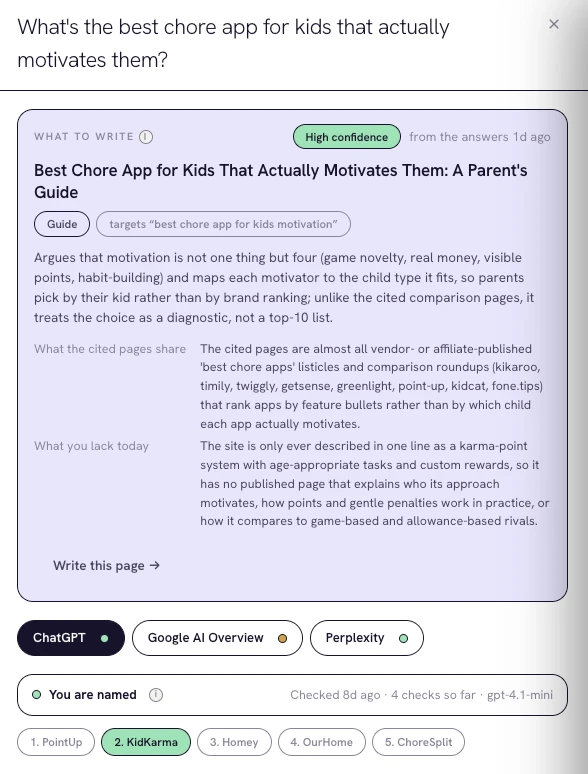
PilotDeck's AI citation analysis tool collects those citations across ChatGPT, Perplexity, Google AI Overviews and Gemini, shows whether you are among them, and lists what to fix or publish so you appear next time.
Free check takes about a minute. No card, no call.
What Is AI Citation Analysis?
AI citation analysis means collecting the references that AI search answers attach to their claims, then measuring how your pages compare with every other page that gets referenced.
A rank report lists positions in a page of links. An AI answer has no such page, so a position number says nothing about whether your content was used. An AI citation analysis tool treats every answer as its own small result set and measures where you stand inside it.
Repeated over weeks, AI citation tracking becomes a trend line. You can see pages gaining or losing references, rivals moving up, and topics where none of your pages has been picked yet.
- Citation — A reference inside an AI answer that points back to the page a statement came from.
- Citation presence — Whether your domain shows up in the reference list for one prompt.
- Citation frequency — The number of times your pages are referenced across a fixed set of prompts and dates.
- Citation context — The wording surrounding your reference, and whether it is correct and matches your positioning.
- Citation gap — A prompt on your topic where other pages are referenced and yours is left out.
How Do I Track Citations in AI Search?
The method is a loop you can repeat: pick prompts, run them, write down every source. PilotDeck does the running and the writing down.
Choose the prompts that matter
List the questions customers put to AI assistants, including ones that name your brand and ones that do not. Group them by topic.
Run them across AI platforms
PilotDeck sends each prompt on a timetable and saves the complete answer with every source and URL it lists.
Review citations and act
Read presence, frequency, context, rival comparison and gaps in a single report, then move the fixes into your content plan.
Five Views of How AI Cites Your Content
A single yes or no hides most of the story. PilotDeck builds these views from every prompt you track.
Citation presence in AI search
Every prompt and platform gets a clear result: cited or not, and which exact URL was used. Pages that never appear become rework candidates.
Citation frequency in AI search
A running tally shows which pages are referenced reliably and which fell away after a rewrite or a competitor launch.
Citation context analysis
Open the full answer next to each reference. Confirm the statement is right, up to date and in line with how you describe your product.
Competitor citation comparison
Run the same prompts for competitors and view the results side by side: the pages they win, the topics they own, and where you trail most.
Citation monitoring
Scheduled runs flag new sources, dropped references and sudden competitor gains, so you can respond while the change is still small.
How to Measure Citation Performance
Four headline numbers, then the detail that explains them. Below is how a tracked prompt set reads once it has run.
Which sources does AI cite most often?
The external sites that influence AI answers on these prompts: reviewers, rivals and communities, as a share of citations.
| Source | Share of citations |
|---|---|
| Third-party reviews | 34% |
| Competitor sites | 29% |
| Your site | 22% |
| Community threads | 15% |
What are citation gaps in AI search?
Prompts where other sources are cited and yours is not.
| Prompt topic | Status | Cited instead |
|---|---|---|
| Agency pricing models | Gap | Competitor pricing page |
| Client reporting templates | Gap | Review roundup |
| Onboarding checklist | Cited | Your guide |
| Workflow automation | Gap | Community thread |
Illustrative sample data, not a measurement of any real site.
Why Does AI Cite Some Websites More Than Others?
Platforms do not publish their full source-picking rules, and each one behaves differently. Still, pages that are referenced again and again usually share a handful of traits you can test on your own content.
They respond to the question quickly
A short, complete reply near the top of a section is simple to extract and credit.
They go deep on the subject
A page that handles related questions together matches more of the smaller queries behind one answer.
They state concrete, credited facts
Named figures, plain definitions and visible authorship give an answer something firm to point to.
They are fresh and easy to fetch
Up-to-date, crawlable pages with a tidy structure are simpler for a platform to find and read.
They get talked about elsewhere
Pages that trusted sites and communities mention tend to resurface across many prompts.
How Can I Improve My AI Search Citations?
Let the report steer your AI search optimization. Begin with gaps on prompts that sit closest to a purchase, then work down this list.
Open sections with the conclusion
State the takeaway first, then support it with detail underneath.
Fill the gaps the report shows
Write or restructure a page for each prompt where rivals are referenced and you are missing.
Correct wrong statements at the source
If an answer misdescribes your product, edit the page it drew from so the right fact is stated plainly.
Show up in the places AI already reads
The source list reveals which review sites and communities are worth joining in your category.
Test again with identical prompts
Hold the prompt list steady so a higher citation rate reflects real progress, not a changed test.
Who Uses Citation Analysis
SEO and content teams
Convert gaps into a ranked content to-do list, then confirm each new page gets picked up for the prompts it targets.
Agencies
Agencies offering AI SEO services can give each client a readable summary of where they are cited and how they compare with rivals.
Brand and product marketers
Verify AI describes your product accurately, and learn which outside pages shape that description.
How Do I Choose AI Citation Analysis Software?
Check what each option actually records. Four differences do most of the work.
| What to check | Asking AI yourself | Typical monitoring tool | PilotDeck |
|---|---|---|---|
| Platform coverage | One platform, one moment | Often a single platform | ChatGPT, Perplexity, AI Overviews and Gemini |
| Sampling depth | One answer | Weekly, often a single run | 20 runs per prompt, daily |
| Competitor comparison | No | Rarely | Side-by-side citation comparison by prompt |
| Is the fix included? | No | No - you get a list | Briefs and published pages, human-reviewed |
For a wider look at the options, read our comparison of citation analysis tools.
AI Citation Analysis: Common Questions
How do I track citations in AI search?
Choose the questions your customers ask, run them on the AI platforms you care about at regular intervals, and note every source each answer lists. For each run, record whether your domain appears, how often across runs, and what the answer says around it. An AI citation analysis tool automates that routine and keeps the history so changes are visible.
How can I compare competitor citations?
Track one shared prompt list for your brand and for each rival. Then compare who appears, how often, and which individual pages are named. Pages that rivals earn and you do not mark the content gaps worth filling first.
What are citation gaps in AI search?
A citation gap is a prompt where AI references other pages, frequently a competitor's, while skipping yours even though you cover the subject. Each gap points to a page you could write, restructure or strengthen.
Why does AI cite some websites more than others?
Pages that reply to the question directly, explore the topic in depth, name facts and authors, stay up to date and are easy to crawl tend to be referenced more. Pages that other trusted sites discuss also resurface often. Exact weighting varies by platform.
How do I measure citation performance?
Pick a few steady metrics: citation rate (the portion of tracked prompts that reference you), citation count over time, your share against rivals, how many different pages get cited, and the quality of the surrounding wording. Keep the prompt list fixed so results compare fairly from one period to the next.
Which sources does AI cite most often?
It varies with the topic and the platform. Typical candidates are publisher and reference sites, product and documentation pages, review sites and community threads. Citation analysis on your own prompts reveals the specific sites and pages that lead.
How can I improve my AI search citations?
Put the conclusion first in each section, cover the topic completely, include specific attributed facts, refresh pages regularly and keep them crawlable. Also build presence on the sources AI already reads in your category, then re-run the same prompts to check the effect.
How do I choose AI citation analysis software?
Check what each option actually records: the AI platforms covered, how many prompts you can track, whether it shows exact URLs and full answers, how it handles competitor comparison, how much history it keeps, and whether you can export the data. Run a small prompt set through a trial first and see if the results change what you would publish.
Find Out Who AI Cites in Your Market
Enter your site and a few prompts to begin. PilotDeck reports where you are referenced, where you are absent, and who takes your place. Takes about a minute.