International SEO Service: How Founders Should Choose One
A practical framework for founders choosing an international SEO service: what agencies actually do, what it costs, and a checklist before you sign.
Read →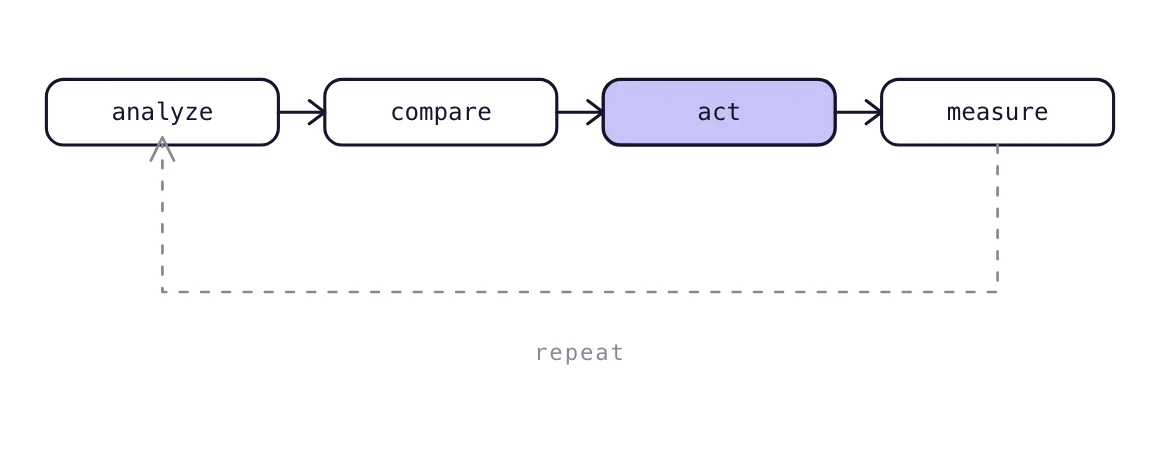
An AI SEO agent can execute your routine SEO tasks with minimal human intervention. It does that by connecting to tools such as analytics platforms, Search Console, and content management systems to audit technical issues, track keyword rankings, monitor AI citations, draft or optimize content, and flag performance changes.
Unlike an AI SEO tool that acts when prompted, AI SEO agents run on a loop of analyzing data → comparing it against a target → taking action → measuring the result → repeating.
Depending on the platform, many handle monitoring and reporting on their own. However, content publishing, backlink outreach, and strategic prioritization still need human review and judgement. The short version: an AI SEO agent replaces the repetitive parts of SEO work, not the judgment calls.
software that uses AI models and pre-set rules to perform SEO tasks, crawling, keyword tracking, content drafting, and citation monitoring, on a repeated schedule with minimal manual input. Unlike a single AI tool answering one prompt, an agent runs continuously: check, compare, act, log.
An AI SEO agent connects to a stack of existing tools through APIs. The usual workflow includes Google Search Console, analytics tools like Semrush or Ahrefs, a CMS, and a rank tracker. It pulls fresh data from these tools on a set schedule, often daily or weekly, and compares it against your previous performance.
If rankings drop, your brand stops getting cited in AI search, or a technical error appears, it either fixes the issue on its own or opens a task for a person to review.
Most AI SEO agent platforms today handle five job categories.
| Task | Manual Process | AI SEO Agent Process |
|---|---|---|
| Technical audit | Weekly crawl, 2 to 4 hours | Continuous crawl, alerts within hours |
| Rank tracking | Spreadsheet updates, 1 to 2 hrs/week | Live dashboard, updated daily |
| Citation monitoring | Rarely tracked manually | Tracked across 5+ AI platforms daily |
| Reporting | Manual deck, 3 to 5 hours/month | Auto-generated, sent on schedule |
Beyond the five core categories, most agents also automate internal link suggestions, duplicate content detection, and schema markup validation. Some connect directly to a CMS and push fixes live, while others draft the fix and wait for human approval.
Automation depth varies by platform. A lightweight tool might only alert on issues. A fuller agent fixes minor technical errors on its own and drafts content for review. The difference matters when you're comparing these products, since two tools can have the same feature list but very different levels of automation.
Agencies managing several client accounts use agents to catch ranking drops the same day they happen, instead of waiting for a monthly report. In-house teams at growing SaaS companies use them to keep technical health steady while a small team focuses on strategy.
At PilotDeck, our automated SEO monitoring setup runs this loop for client sites daily, which is how a two-person content team keeps pace with accounts that used to need a dedicated analyst.
Enterprise interest in this kind of automation is accelerating. Only 17% of organizations have deployed AI agents so far, yet more than 60% expect to within two years, according to the 2026 Gartner CIO and Technology Executive Survey (April 2026). SEO is one of the functions leading that shift, since ranking and citation data changes daily.
Agents can spot changes in the data, but they don't always understand why those changes happened. A ranking drop caused by a Google algorithm update may look similar to one caused by a technical error, even though the right response to each is completely different. The agent can flag the problem and investigate possible causes, but understanding the broader context still requires human judgment.
To put this into perspective, think of an AI SEO agent as a team member that can execute tasks on your behalf. It can monitor performance, identify problems, make routine changes, and report back on what it finds. But you still decide the bigger questions: which markets to enter, what the brand should say, and which opportunities are worth pursuing.
No, not in 2026. An AI SEO agent handles repeatable tasks like crawling, tracking, drafting, and reporting well. The caveat is that it doesn't replace human judgment when it comes to prioritizing pages, interpreting ambiguous data, or deciding between approaches like GEO and AEO.
The realistic model is a person directing several agents, not an agent working alone. Teams that pair a strategist with two or three agents report faster output without losing quality control.
Before signing up, agencies should decide the guardrails: which tasks the agent fully automates versus flags for review, how often it pulls fresh data, and whether it tracks citations across AI platforms or just traditional rankings.
Pricing models vary too. Some platforms charge per site, others per keyword tracked, and a few charge per AI platform monitored. Ask for a trial period before committing a full client roster to one system.
Even strong AI summaries don't guarantee traffic. Google users click through to a website less often when an AI-generated summary appears on the results page, Pew Research Center found in its analysis of March 2025 browsing data (July 2025). Winning a citation and moving a business's core traffic numbers are two different things.
Start with the problem that hurts most today. A team drowning in reporting needs a different agent from one that keeps discovering ranking drops weeks too late.
Match the automation depth to team size next. A two-person team benefits from an agent that fixes issues on its own. A larger team with dedicated analysts might only need alerts, since people are already there to act on them. At PilotDeck, our guide to tracking brand mentions in ChatGPT walks through setting citation alerts as a first step for teams testing this kind of automation.
An AI SEO agent is a tool for catching what a busy team misses: a ranking drop, a lost citation, a technical error, before it costs traffic. It doesn't replace an SEO strategist's judgment, but it gives that strategist better, faster data to work with.
It audits technical issues, tracks rankings and AI citations, drafts content, and sends alerts on a schedule, with minimal human intervention.
It connects to tools like Search Console and a CMS through APIs, pulls fresh data on a schedule, and compares it against a target to decide what action to take.
Technical audits, rank tracking, citation monitoring, reporting, and some can even automate content drafting and publishing, and internal linking, depending on the platform.
It can handle the routine tasks on its own. Strategy, prioritization, and brand-voice decisions still need a person.
Faster issue detection, daily instead of monthly reporting, and citation tracking across AI platforms that most teams don't monitor manually.
Not in 2026. It does replace repetitive tasks, but not the judgment calls around strategy and prioritization.
A practical framework for founders choosing an international SEO service: what agencies actually do, what it costs, and a checklist before you sign.
Read →Discover what an AI SEO agency does, typical pricing, and how to pick the right one for your site, see the key questions to ask before you hire.
Read →
Compare Grok vs ChatGPT in 2026 and find out which AI assistant is better for research, writing, coding, real-time information, reasoning, and daily tasks.
Read →Hand over a domain. Research runs and your first article is written within the hour.
Start free trialCancel any month. Your site and content stay yours.