International SEO Service: How Founders Should Choose One
A practical framework for founders choosing an international SEO service: what agencies actually do, what it costs, and a checklist before you sign.
Read →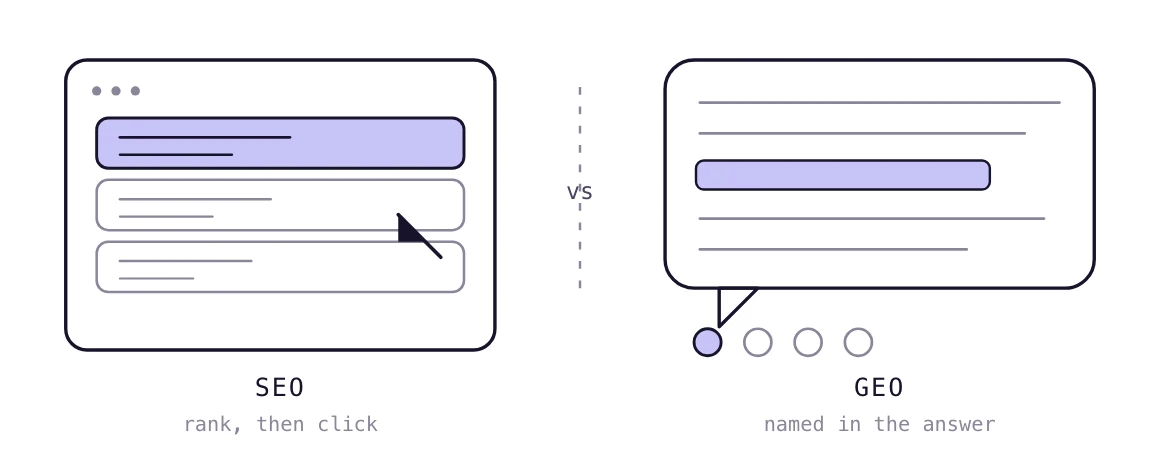
SEO optimizes websites to rank in traditional search results, while GEO (Generative Engine Optimization) focuses on getting content and brands surfaced, mentioned, or cited in AI-generated answers. They overlap in areas such as content quality, relevance, authority, and technical accessibility, but GEO adds a focus on how AI systems understand and use information. GEO does not replace SEO. For most businesses, SEO and GEO work best together.
Search is no longer just about typing a query and scrolling through blue links. You already see it happening. Google still matters, but now people are also asking AI tools for instant answers, comparisons, and recommendations. That shift has quietly introduced a new concept: Generative Engine Optimization (GEO).
So when people say GEO vs SEO, they're really asking: how do I stay visible when search itself is changing? SEO is about ranking in traditional search results. GEO is about showing up inside AI-generated answers. They're closely connected but not the same, and understanding the difference is becoming essential for modern visibility.
Search engine optimization (SEO) is the practice of improving a website and its content so that search engines can understand, index, and rank it for relevant searches. The goal is usually visibility in search results, followed by clicks, organic traffic, and conversions.
Generative engine optimization (GEO) focuses on visibility in AI-generated search experiences. Instead of trying only to get a page to rank in a list of results, the goal is to increase the likelihood that an AI system understands your content and uses, mentions, or cites it when generating an answer.
A simple way to think about the difference is:
That difference matters because traditional search and generative search don't present information to users in the same way.
| SEO | GEO | |
|---|---|---|
| Optimizes for | Traditional search engines | Generative AI and AI-powered search |
| Primary goal | Rankings, visibility, and clicks | AI visibility, mentions, and citations |
| User experience | User chooses from search results | AI synthesizes information into an answer |
| Core focus | Relevance, technical SEO, content, and authority | Clear, useful, answerable content plus authority and context |
| Typical metrics | Rankings, impressions, CTR, and organic traffic | AI mentions, citations, visibility, and AI-referred traffic |
| Search behavior | Search, results, click | Question, answer, possible follow-up |
The distinction is useful, but it shouldn't make GEO and SEO sound like completely separate disciplines. A large part of what makes content useful for search engines also makes it useful for AI systems.
GEO doesn't mean starting your content strategy from scratch.
Both SEO and GEO depend on a strong underlying website and useful content. That includes several fundamentals.
This is why GEO and SEO are better viewed as overlapping strategies rather than competing ones. Much of the SEO work you are already doing can form the foundation for GEO.
The difference is what happens after that foundation is in place.
The biggest difference is the outcome you are optimizing for.
With SEO, you generally want a page to appear prominently in search results so a user can click through to your website. With GEO, the user may never see your page in a traditional list of results. An AI system may instead use information from your page, combine it with other sources, and present the user with a synthesized answer.
That changes how you think about content.
SEO places significant emphasis on relevance, crawlability, site structure, content quality, links, and other factors that influence traditional rankings. GEO puts additional emphasis on whether information is clear, specific, well-supported, and easy for an AI system to understand and use in an answer.
The way you measure success also changes.
For SEO, you can track rankings, impressions, click-through rates, organic traffic, and conversions. For GEO, you may also want to know whether your brand appears in AI answers, how often it is mentioned or cited, which competitors appear instead, and whether the information an AI system provides about your business is accurate.
So GEO isn't simply "SEO for ChatGPT." It changes both the visibility you are pursuing and how you evaluate that visibility.
No, GEO cannot replace traditional SEO for most businesses.
Traditional search remains an important way for people to discover businesses, products, services, and information. If your website has poor technical foundations, weak content, or little search visibility, adding GEO tactics won't solve those underlying problems.
There is another reason not to treat them as replacements: the two strategies share so much foundational work.
A well-structured website with useful, authoritative content can support both traditional search visibility and visibility in AI-powered search experiences.
The better question isn't whether GEO should replace SEO. It's how much attention your business should give to each channel based on how your customers search. Check this guide on how to track brand mentions in ChatGPT.
For most businesses, yes.
SEO helps build visibility in traditional search. GEO adds another layer for people who discover information through AI-powered search and recommendation experiences.
A practical approach is to:
The important point is that GEO should not become a completely separate content operation. Instead, look at your existing SEO strategy and identify where your content could be clearer, more useful, more authoritative, and easier for AI systems to interpret.
There isn't one answer for every business.
SEO matters more if most of your customers discover you through Google and other traditional search engines, especially if you are still building your organic visibility. A business with weak SEO fundamentals shouldn't abandon them to chase AI visibility.
GEO deserves more attention if your customers increasingly use AI tools to research products, compare options, find recommendations, or decide which businesses to consider. This can be particularly relevant for businesses where the research process happens before a customer ever visits a website.
For most businesses, however, the answer is both.
SEO remains an important foundation for organic discovery, while GEO addresses an additional way people are finding and evaluating information. The question isn't really "GEO vs SEO, which is better?" It's where your potential customers are searching and whether your business is visible there.
SEO and GEO aren't competing versions of the same strategy. SEO helps your business get discovered through traditional search, while GEO focuses on being represented in AI-generated answers.
They share many of the same fundamentals, but GEO adds another layer around how information is understood, surfaced, mentioned, and cited by generative search systems.
If you're looking to bring SEO and GEO together, PilotDeck is a good place to start.
For most businesses, the smartest approach isn't choosing between GEO and SEO. It's building a strong SEO foundation and adapting it for a search environment where people increasingly get answers, not just lists of links.
GEO vs SEO isn't really a choice between two competing strategies. SEO helps your business earn visibility in traditional search, while GEO focuses on how your brand and content appear in AI-generated answers. They share many of the same foundations, including useful content, relevance, credibility, and a technically accessible website.
For most businesses, the best approach is to keep building a strong SEO foundation while adapting content for AI-powered search. As search evolves from lists of links to generated answers, being visible in both places gives your business more opportunities to be discovered.
SEO focuses on improving a website's visibility and rankings in traditional search results. GEO, or Generative Engine Optimization, focuses on increasing the likelihood that a brand or its content is mentioned, surfaced, or cited in AI-generated answers.
Neither is universally better. SEO remains important for traditional search visibility, organic traffic, and website discovery, while GEO matters for visibility in AI-powered search. For most businesses, using both makes more sense than choosing one over the other.
No. GEO does not replace traditional SEO. The two approaches overlap significantly, and strong SEO fundamentals can support GEO. Businesses that depend on organic search traffic still need to maintain their traditional SEO strategy while adapting to AI-powered search.
AEO (Answer Engine Optimization) focuses on making content more likely to appear as a direct answer to a user's question, while GEO focuses more broadly on visibility in generative AI experiences. The terms overlap, and they are not always used consistently. In practice, both aim to make your content easier for answer and AI systems to understand and surface.
Yes. SEO is still worth investing in if your customers use traditional search to discover products, services, or information. AI search has added another discovery channel, but it hasn't made organic search irrelevant. The better approach in 2026 is to build a strong SEO foundation while adapting your content and visibility strategy for AI-powered search.
A practical framework for founders choosing an international SEO service: what agencies actually do, what it costs, and a checklist before you sign.
Read →Discover what an AI SEO agency does, typical pricing, and how to pick the right one for your site, see the key questions to ask before you hire.
Read →
Compare Grok vs ChatGPT in 2026 and find out which AI assistant is better for research, writing, coding, real-time information, reasoning, and daily tasks.
Read →Hand over a domain. Research runs and your first article is written within the hour.
Start free trialCancel any month. Your site and content stay yours.