AI Visibility Audit: The Free 9-Step Checklist
Run this free 9-step AI visibility audit yourself in one sitting to see if ChatGPT, Perplexity, and AI Overviews can find and cite your site.
Read →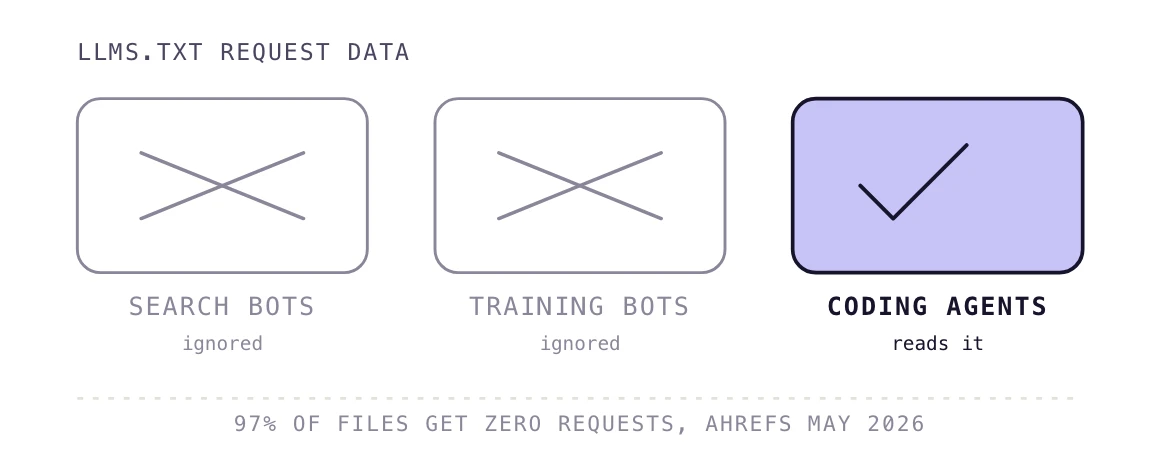
No, llms.txt does not improve AI citations in 2026. Ahrefs analyzed 137,210 domains and found that 97% of published llms.txt files received zero requests in May 2026. Google's own generative AI search guide lists llms.txt among tactics site owners can ignore entirely. AI retrieval bots such as OAI-SearchBot and PerplexityBot made up only 1.1% of the few requests these files did get. So for most businesses chasing mentions in AI Overviews, ChatGPT, or Perplexity, llms.txt is not the lever that moves the needle.
llms.txt itself is a plain Markdown file placed at a website's root. It lists a site's key pages so AI systems can reference them without crawling everything. Proposed in 2024 as a lightweight alternative to full-site crawling, no major AI platform has committed to reading it inside production search or citation systems.
llms.txt is an index file, not a ranking signal or crawler directive. It sits at a domain's root in Markdown format and points AI systems toward important pages on the site.
Think of it as a map, not a set of directions. It can show an AI system what you consider important, but it can't force the system to crawl, trust, or cite those pages.
Unlike robots.txt, it doesn't control crawler access. And unlike a ranking signal, it doesn't directly improve your visibility. If you're trying to separate llms.txt hype from the AI-visibility work that actually matters, it's worth understanding where GEO and AEO diverge, since the two are often confused.
In June 2026, Ahrefs published a study analyzing 137,000+ domains to see how llms.txt files are actually being used. The results were pretty clear: 97% of published llms.txt files received zero requests of any kind in May 2026. Among the small share that were fetched, AI retrieval bots accounted for just 1.1% of that traffic.
Named AI tools overall made up 19.5% of requests, but most of that came from coding agents rather than AI search crawlers.
We see the same pattern across PilotDeck client accounts. Sites that gained AI citations did it through fresh, well-structured content, not through an llms.txt file.
"Ahrefs' own numbers show that SEO audit tools generate more llms.txt traffic than any AI bot category combined. That is the file's real audience today, not AI search." — JC, Co-founder, PilotDeck
SEO audit tools alone produced more llms.txt requests (21.7%) than every AI bot category combined, meaning the industry checking for the file outreads the AI systems it was built for.
AI crawlers like GPTBot, ClaudeBot, and PerplexityBot are built to read HTML pages directly, so a separate summary file gives them nothing they can independently verify. Retrieval-augmented generation systems pull from indexed, crawled content, not from a webmaster's self-description.
The same research found zero AI bots requesting llms.txt on domains where the file did not exist. So AI systems aren't exactly scouring the web looking for your missing llms.txt file. Publishing one doesn't appear to be what puts a site on their radar.
| Bot Category | Share of llms.txt Requests |
|---|---|
| SEO audit tools | 21.7% |
| General web crawlers | 13.1% |
| AI agents (e.g., coding assistants) | 10.5% |
| AI training crawlers | 5.3% |
| AI retrieval bots (search/citation) | 1.1% |
Before publishing anything, it also helps to check which AI crawlers you currently allow, since a stale llms.txt raises security questions faster than SEO ones.
No. Google's guide to optimizing for generative AI search lists llms.txt under tactics site owners can ignore, according to its generative AI optimization guide (2026). The guide states plainly that Google Search does not use machine-readable files, AI text files, or Markdown copies as a visibility input.
What still matters is the same technical and content foundation that has always driven organic rankings: crawlable pages, clear structure, and content people find genuinely useful. Google's guidance covers its own generative AI features specifically, though independent crawl data shows the same low engagement pattern across ChatGPT, Claude, and Perplexity too.
Yes, but treat it as nice to have not something to bet your AI visibility on. The file costs little to build, and the llms.txt generator among PilotDeck's free SEO tools can draft one in minutes, but it neither helps nor hurts rankings or citations either way, based on every data point gathered so far.
The clearest use case is coding agents. Claude Code out-fetched every AI search and retrieval bot in the Ahrefs dataset, so teams with developer-facing products may see more return than a marketing-only site would. Checking AI visibility tracking tools first will tell you whether the effort is worth your time at all.
We still ship llms.txt for client sites when the build takes minutes, but we never report it as an AI-visibility win in a client's monthly numbers. The data does not support that framing, and setting the wrong expectation costs more trust than the file could ever earn back. — JC, Co-founder, PilotDeck
Keep it short, link only to pages you maintain, and treat it like code, not a marketing asset. A bloated or stale file works against the one use case that still holds up.
Website builders like Wix, Framer, and Lovable are starting to auto-generate llms.txt by default, which means adoption will keep climbing even without any confirmed citation benefit.
At PilotDeck, we fold this kind of check into monthly site audits, so it never becomes a project of its own.
llms.txt is cheap to publish and easy to overestimate its effectiveness. The 2026 data is consistent across every major study: AI search and citation systems are not reading it, and Google has said as much directly.
Spend the effort instead on content structure, freshness, and third-party mentions, since those are the levers with measured ties to AI citations. Ship llms.txt if it takes half an hour. Do not build a strategy around it.
llms.txt was designed to give AI systems and coding agents a short, curated index of a site's key pages. It saves an agent from crawling an entire domain to find relevant context, especially for developer documentation.
Documentation platforms and developer tools are the main adopters, since coding agents like Claude Code read these files more than any AI search or retrieval bot does. General business sites see almost no bot interest in the file.
No. robots.txt controls what crawlers may access, and every major crawler honors it. llms.txt controls nothing; it is an unenforced description that AI systems can ignore completely, and most of them do.
Possibly, if AI agents start mediating more of the web instead of retrieval bots fetching pages directly. Website builders like Wix and Framer are already generating the file by default, which will raise adoption regardless of any confirmed benefit.
Keep it to a short list of your most important pages, each with a one-line description and a working link. Skip your full sitemap, marketing copy, or anything you are not prepared to maintain quarterly.
No, publishing one does not harm rankings or citations. The risk is not the file itself but treating it as a strategy, which can quietly displace the work that does move AI visibility.
Run this free 9-step AI visibility audit yourself in one sitting to see if ChatGPT, Perplexity, and AI Overviews can find and cite your site.
Read →See what SaaS SEO services actually include, when DIY and AI tools stop working, and how to evaluate an agency, read on before you hire one.
Read →
Learn what conversion optimization consulting covers, real benchmarks by traffic stage, and whether your conversion rate or your traffic is the actual problem.
Read →Hand over a domain. Research runs and your first article is written within the hour.
Start free trialCancel any month. Your site and content stay yours.