SaaS SEO Services: What They Include, When You Need Them, and How to Choose
See what SaaS SEO services actually include, when DIY and AI tools stop working, and how to evaluate an agency, read on before you hire one.
Read →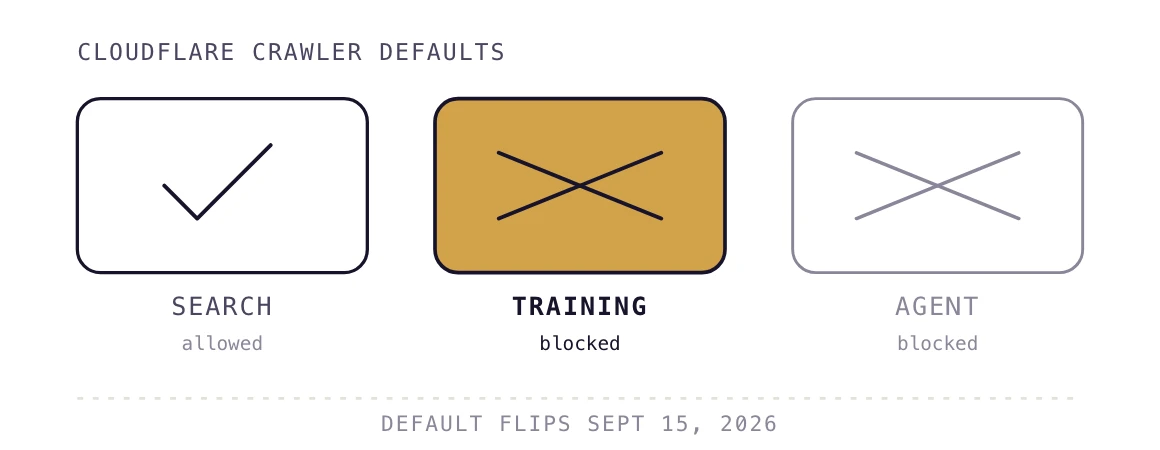
Starting September 15, 2026, Cloudflare is flipping the default settings for a huge chunk of the sites it runs. Every brand-new site, every site still on the free plan, and any new site added under an existing account will get affected. Cloudflare will now be sorting bots into three buckets: Search, Training, and Agent. If a page has ads on it, Search bots still get in by default, but Training and Agent bots get blocked unless the site owner flips them back on manually. And any bot that won't say which of the three it's actually doing? It just gets shut out of ad-supported pages altogether.
Cloudflare replaces its single AI/non-AI bot toggle with three separate crawler categories, each carrying its own default. Search crawlers keep collecting content to answer questions later, so they stay allowed on ad-supported pages. Training and Agent crawlers, along with any crawler that won't declare its purpose, get blocked on those same pages by default.
| Crawler Type | What It Does | Default After Sept 15 (Ad Pages) |
|---|---|---|
| Search | Indexes content to answer future queries | Allowed |
| Training | Collects content to train or fine-tune a model | Blocked |
| Agent | Acts in real time on a person's behalf | Blocked |
| Mixed-use / undeclared | Blends two or more of the above | Blocked |
Three groups inherit the new defaults automatically: brand-new Cloudflare customers, new sites added under an existing account, and every site still on the free tier. Existing paying customers keep their current bot settings until they log in and change them.
Bot traffic passed human traffic on the open web for the first time this year, months earlier than expected. Cloudflare points to mixed-use crawlers, bots that blend search, training, and agent behavior into one, as the real problem. Because these crawlers don't separate out what they're actually doing, site owners are stuck with an impossible choice: block them entirely and disappear from AI search results, or allow them and hand over their content for free training and reuse with zero compensation. Transparent AI companies lose out too, since they get lumped in with, and penalized alongside, bots that refuse to disclose their intent.
"Now that the majority of traffic on the Internet is non-human, we must go further and act faster so that a sustainable ecosystem can emerge," said Cloudflare co-founder and CEO Matthew Prince, announcing the policy (Cloudflare, July 2026).
Cloudflare also argues the change levels a playing field it says favors the largest search engine, which it estimates has access to roughly twice the web content available to other AI companies, because staying discoverable in search has effectively required accepting AI training too (TechCrunch, July 2026).
Multi-purpose crawlers get evaluated under every policy they touch, not just one. If a site blocks Training crawlers, crawlers such as Googlebot, Applebot, and Bingbot get blocked too, even on sites that still allow Search, because those bots currently perform more than one function at once (Help Net Security, July 2026).
Site owners who want Google Search traffic but not Google's AI training crawlers will need Google to ship a bot that separates the two before September 15 changes anything for them.
Pay Per Use is Cloudflare's answer to the compensation half of the problem. It replaces last year's Pay Per Crawl marketplace, which charged AI companies per fetch regardless of whether the content did anything for the answer that followed.
Under Pay Per Use, publishers get paid when their content actually shapes an AI answer, not just when a bot reads it. Launch partners Ceramic.ai and You.com pay publishers per query and per on-demand content access, respectively.
Agencies already running automated SEO monitoring on client sites are best placed to catch which pages start earning under the new model, since the payouts depend on citation, not crawl volume.
Four steps cover most of what a site needs before September 15:
Check current AI Bot Control status. Log into Cloudflare's Security settings and see exactly where the account stands today, including whether the legacy "Block AI bots" toggle is still on, since it now enforces against the new categories too.
September 15 doesn't ask site owners to block AI. It asks them to decide, crawler by crawler, what they're comfortable giving away for free. The sites that check their settings this week keep that choice. The ones that don't will find Cloudflare has already made it for them.
Yes, if you're an existing paying customer on an existing site. Opt out through Security settings before the deadline if you're on the free tier or adding a new site and want to keep the old behavior.
Not on its own. Search crawlers stay allowed by default. Googlebot only gets blocked if a site owner blocks Training crawlers, since Googlebot currently performs both functions.
Any bot that blends two or more of Search, Training, and Agent behavior without letting the site owner separate them. Cloudflare blocks these by default on ad-supported pages starting September 15.
No. The new defaults only fire on pages Cloudflare classifies as ad-supported. Content and documentation pages without ads aren't affected by the September 15 change.
Cloudflare's compensation model pays publishers when their content shapes an AI answer, replacing last year's per-fetch Pay Per Crawl marketplace. Ceramic.ai and You.com are the first launch partners.
Log in to the Cloudflare dashboard and open Security settings, then AI Bot Control. The three categories, Search, Training, and Agent, show their current status per site.
See what SaaS SEO services actually include, when DIY and AI tools stop working, and how to evaluate an agency, read on before you hire one.
Read →
Learn what conversion optimization consulting covers, real benchmarks by traffic stage, and whether your conversion rate or your traffic is the actual problem.
Read →75 sourced statistics on how fast generative AI is spreading, what it costs, who uses it at work, and whether people trust it, with every figure labeled and linked to its source.
Read →Hand over a domain. Research runs and your first article is written within the hour.
Start free trialCancel any month. Your site and content stay yours.