Digital Marketing Agencies for Startups: How to Choose the Right Partner
Compare digital marketing agencies for startups, SEO-only vendors, and AI-native visibility partners to decide what fits your launch stage.
Read →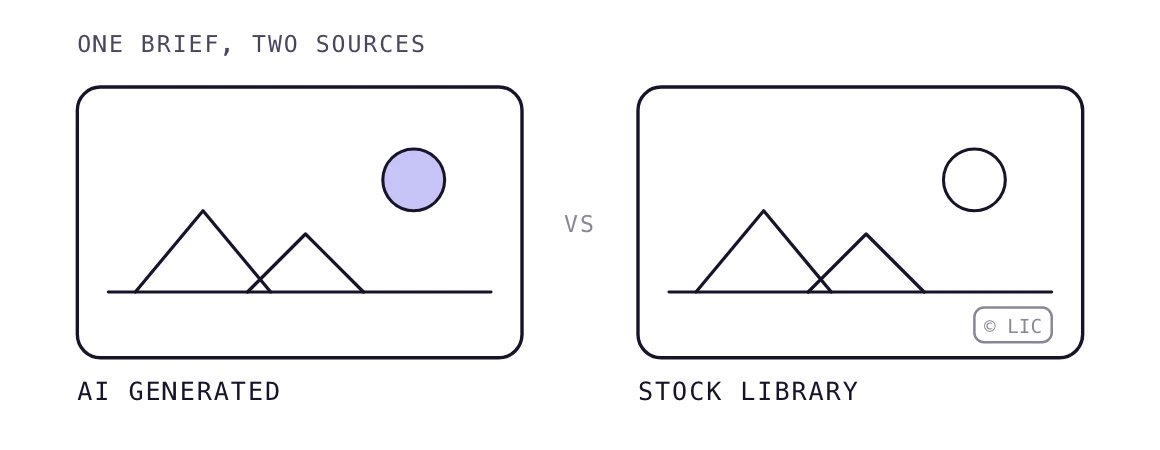
AI images usually win for content marketing. They cost less per asset, match your brand style on command, and come with clear commercial licensing. Stock photos still earn their place when a post needs a real, verifiable event, a named location, or an actual person. The right call depends on what the image needs to prove, not just what it needs to show.
AI images are visuals created by generative models like Midjourney or Adobe Firefly from a text prompt.
Stock photos are pre-shot photographs licensed from a library such as Shutterstock or Getty Images. AI images generate on demand and can match brand guidelines exactly, while stock photos are fixed assets licensed for reuse.
If you are a content marketer who often is in need of images for ads, blogs, landing page, website and all the works or are simply someone who operates a blog, you might have stumbled across the new age question of whether to go for an AI generated image or a stock photo.
Both have their pros and cons, also it depends on each individual case.
Some brands can't really compromise with their brand aesthetics or have an oddly specific visual in their mind, which stock photos might not satisfy. So finding them becomes ridiculously hard. So, for them AI generated photos work the best.
But for brands who like more natural and original photos, there is nothing like a stock photo, even if sourcing them is a bit hard.
Don't worry, if you are still on the fence trying to decide which one you should opt for, you are in the right place. This guide compares cost, speed, licensing, and search performance so you can choose confidently for each piece of content you publish.
The core difference is origin, not quality. AI images generate from a text prompt in seconds, while stock photos are pre-shot files licensed from an existing library.
AI generation gives unlimited variations of one concept, so brand colors and poses can match exactly every time. Stock photography instead gives a real, unaltered photograph, which matters when authenticity is the message itself.
If every other blog or website uses the same person sitting on the desk with a laptop, the entire marketing piece falls flat and looks blah.
AI images win on cost, speed, and originality for most blog posts, social graphics, and landing pages. A single AI image generation tool can replace hundreds of one-off stock licenses within a few months.
Stock photos still win when you need a real event, a named location, or a recognizable public figure the AI cannot legally recreate. For everyday marketing visuals, AI is the more practical default.
At PilotDeck, we moved most client blog imagery to AI generation last year. Turnaround dropped from two days to under an hour, and no client has raised a licensing concern since. — Alpesh D., Co-Founder, PilotDeck
Stock photos still make sense in three specific situations. Each one involves proof that AI cannot manufacture.
Consumer trust research backs this up: nearly 90% of consumers want to know when an image is AI-generated, according to Getty's brand trust report (April 2024). At PilotDeck, every AI visual gets flagged internally before it goes live for exactly this reason.
AI images cost less per asset, generate in minutes, and typically include broader commercial licensing than stock subscriptions. Stock photos cost more per download but guarantee a real, unaltered photograph shot by a professional.
| Factor | AI Images | Stock Photos |
|---|---|---|
| Cost per image | Low, subscription-based; often a few cents at scale | $1–$50+ per license; more for exclusive rights |
| Turnaround | Seconds to minutes | Minutes to hours, including search and licensing |
| Customization | Full control over style, color, and pose | Fixed to what was originally shot |
| Licensing | Commercial rights often included; varies by tool | Governed by license tier (royalty-free or rights-managed) |
| Best for | Blog graphics, social posts, brand-consistent visuals | Real events, public figures, documentary content |
Licensing terms deserve a close read either way. Some stock tiers restrict how many impressions or which platforms an image can appear on, while AI tools vary on whether commercial rights are automatic or require a paid plan.
On cost, speed, and licensing, AI wins by a wide margin for routine marketing visuals. The one column that never moves in AI's favor is documented, real-world authenticity, which is exactly the gap stock photography still fills.
Now, this one's tricky. AI generated images aren't protected by copyright laws, meaning that your competitors or anyone really can use your image and you won't be able to do anything about it. However, there are workarounds you can do to protect your assets. You can perform heavy editing and use your creativity on top of the AI generated output that no one else can copy, to call it your own. Also using highly specific prompts can help you generate a highly specific image that is hard to get.
As a workaround, use your brand logo and add your brand aesthetic elements to the AI generated image to make the image truly unique.
AI images do not directly influence rankings in Google AI Overviews or chatbot answers. What matters more is whether the surrounding text and image alt copy are structured for citation.
"The image source rarely decides whether AI search engines cite a page. Clear structure, direct answers, and sourced data decide that, no matter where the picture came from." — Alpesh D., Co-Founder, PilotDeck
Fast-loading, properly compressed AI images can even help page speed, since files generate at the exact dimensions you need. Pair them with a genuine data point and clean headings, and image source becomes a minor ranking factor at most.
Match the image source to what the image needs to prove. If a claim just needs an example, generate it; if it needs verifiable proof, license it.
Most teams that adopt PilotDeck's automated content workflow end up using AI for roughly 80–90% of their visuals and stock for the remainder. Pairing that mix with an AI SEO optimization approach keeps images and copy working toward the same citation goal.
Choose AI images by default for blogs, social, and landing pages. Reach for stock or original photography only when the image itself has to prove something happened.
The shift is already reshaping the stock photo industry itself. Getty Images called off its planned merger with Shutterstock in mid-2026 after UK regulators intervened, a deal both companies had pursued specifically to compete with AI image tools (June 2026). Even two of the largest libraries in the industry see AI generation as the bigger competitive threat, not each other.
AI images now handle most day-to-day content marketing needs at a fraction of the cost and time. Reserve stock or original photography for events where authenticity is more important.
But testing both approaches is the best way to go forward. A/B test it on a post, track engagement, and let the results guide your default going forward. The tools will keep improving either way, so revisit this decision every few months rather than treating it as permanent.
For most content marketing, yes. AI images cost less, generate faster, and match brand style exactly. Stock photos remain better only when a real, verifiable image is required, such as a specific event or person.
AI images are generated from a text prompt using tools like Midjourney or Firefly. Stock photos are pre-shot photographs licensed from a library like Shutterstock. One is created on demand; the other is a fixed, previously captured asset.
Use AI images as your default for blog posts, social graphics, and ads. Switch to stock or original photography when you need a documented, real event or person the AI cannot legally recreate.
Yes, for most everyday marketing assets. They are cost-effective, fast, and easy to keep on-brand across dozens of pieces of content, provided the results are reviewed before publishing.
Image source itself does not directly affect search rankings or click-through rates. What performs better is relevance, quality, and how well the image supports the surrounding text and claims.
Lower cost, faster turnaround, unlimited variations, and more creative control. You can create visuals tailored to your brand instead of relying on stock images that other brands may also use.

Compare digital marketing agencies for startups, SEO-only vendors, and AI-native visibility partners to decide what fits your launch stage.
Read →
What a saas content marketing agency does for AI-built sites, how to pick one, and where GEO/AEO fits. A practical buying guide for founders.
Read →
A practical framework for founders choosing an international SEO service: what agencies actually do, what it costs, and a checklist before you sign.
Read →Hand over a domain. Research runs and your first article is written within the hour.
Start free trialCancel any month. Your site and content stay yours.