International SEO Service: How Founders Should Choose One
A practical framework for founders choosing an international SEO service: what agencies actually do, what it costs, and a checklist before you sign.
Read →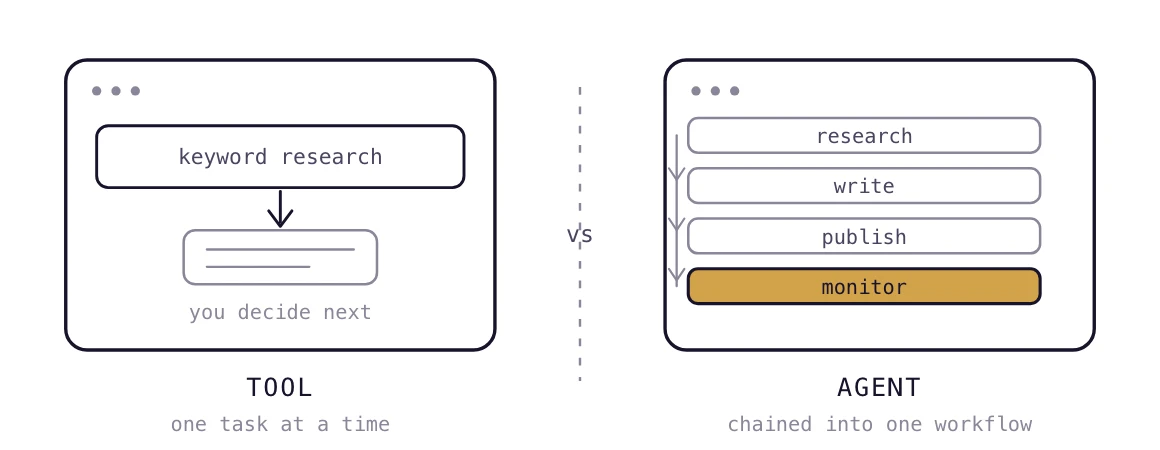
An AI SEO agent plans and executes multi-step SEO work on its own, which includes research, drafting, publishing, and monitoring.
While an AI SEO tool waits for a person to run each task and interpret the output.
The core difference is autonomy. Tools assist; agents act.
The right choice depends on how much of your SEO pipeline you want to hand off versus manage yourself. This guide breaks down what each one does, where they overlap, and when one makes more sense than the other.
SEO has always been a game where rules keep changing. Just when marketers think they have mastered search, a new update rolls out and everyone is back to square one. And now as AI search has taken over, it raises a practical question: whether you should use AI SEO tools or AI SEO agents.
First things first, let's understand what an AI SEO agent actually is.
An AI SEO agent is software that executes a multi-step SEO process toward a predefined goal, without waiting for human instructions at every stage.
In practice, you give the agent an objective, for example, to grow organic traffic to a pricing page. It then decides what data to pull and what actions to take along the way. It can research, write, optimize, publish, and monitor the results as part of one continuous workflow. If you want to automate more of your SEO process, this guide explains how.
Many agents also retain context across sessions, allowing them to build on previous actions instead of starting from scratch each time.
An AI SEO tool is built to handle a specific task when you run it. Keyword research platforms, rank trackers, and content-scoring editors are all examples. You provide the input, review the output, and decide what happens next. AI can make these tools much faster and more capable, whether that means generating meta descriptions, analyzing content, or suggesting keywords. But the tool stops at that task. It does not decide what to do next or connect the next steps without your direction.
The gap comes down to three things: autonomy, scope, and memory.
Tools follow instructions one task at a time; agents pursue a goal across many tasks.
Tools execute a single function; agents chain research, writing, optimization, and monitoring into one workflow.
Some platforms like PilotDeck support both approaches. You can use its SEO functions individually when you want control over each step, or connect them into a more autonomous workflow when you want to hand off more of the process.
| Aspect | AI SEO Tool | AI SEO Agent |
|---|---|---|
| Autonomy | Waits for your input at each step | Acts toward a goal with minimal prompting |
| Scope | Handles one task (keywords, scoring, tracking) | Chains research, writing, publishing, monitoring |
| Memory | Starts fresh every session | Retains context and learns from past runs |
| Output | Data or a draft for you to use | Completed, published, or monitored work |
| Human role | Operator running each step | Reviewer approving key decisions |
Neither format is inherently better. A tool keeps a human in control of every decision; an agent trades some of that control for speed. Pick based on how much oversight a workflow genuinely needs, not on which term sounds more advanced.
Agents can take over parts of your SEO process that individual SEO tools cannot handle on their own.
Gartner predicts that 40% of enterprise applications will feature task-specific AI agents by the end of 2026, up from less than 5% in 2025. As agents become more common in software, the distinction matters for SEO too: instead of using separate tools for research, content, optimization, and monitoring, an agent can connect those steps.
Tasks AI SEO agents can automate include:
An agent isn't completely hands-off. How well it performs still depends on how well it is configured and guided. The better the instructions, context, and rules you give it, the more reliably it can carry out the task the way you want.
Use an SEO tool when the task is complex enough that you want to review and make decisions at each step. For example, a technical audit, competitor analysis, or keyword research project may require context and judgment that you don't want to hand over entirely to an agent. A tool can speed up the individual steps while keeping you in control of what happens next.
An AI SEO agent makes more sense when your team is spending hours on repetitive SEO tasks that follow a similar process every time. This is especially useful for small teams that don't have the bandwidth to handle every step manually. An agent can take care of the repetitive work while keeping a human in the loop whenever a decision needs human judgment or approval.
Most teams do not need to choose one and abandon the other. We run an agent for the repetitive content cycle and keep a tool in hand for research that genuinely needs a human eye.
No, not fully. Agents still rely on underlying data like keyword volume, backlink indexes, and SERP positions, which come from the same research infrastructure SEO tools have always provided.
What an agent replaces is the manual handoff between tasks, not the data itself.
This is why most organizations are adding AI agents to their existing tool stack rather than replacing their tools with agents.
Agencies managing multiple client accounts benefit most from agents, because the repetitive parts of SEO, briefs, drafts, publishing, monitoring, multiply across every client. An agent that handles that cycle for ten accounts frees strategists for work that actually needs a person: positioning, client communication, and interpreting what the data means. Smaller agencies with one or two clients may find a tool-based workflow easier to manage.
PilotDeck was built around exactly this agency use case, pairing agent-run production with human strategy oversight.
An in-house team publishing one article a month is usually better served by a tool. An agency or content team publishing weekly, across several sites, gets more value from an agent. The volume is exactly where autonomy pays off.
The choice is not about an SEO agent or SEO tool, it is rather about how much of the SEO pipeline you are ready to hand off.
Map where your team spends the most repetitive hours, then decide whether that bottleneck calls for a tool that speeds up one task, or an agent that runs the whole cycle around it.
A tool performs one task when you run it and hands the output back to you. An agent pursues a goal across several tasks like research, writing, publishing, and monitoring, with minimal prompting at each step.
Neither is universally better. Agents save time on repetitive, high-volume work; tools give tighter control over one-off or judgment-heavy tasks. The right pick depends on your publishing volume and oversight needs.
Agents chain multiple steps into one workflow and retain memory across sessions. Tools execute a single function per run and start fresh each time, with no memory of prior sessions.
Agents can research, draft, publish, and monitor content without a person managing each handoff, and can decide which data source to check based on context rather than a fixed input.
No. Agents depend on the same keyword, backlink, and SERP data that tools provide. Most agents run on top of existing tool infrastructure, so the two are complementary rather than competing.
Agencies managing multiple client accounts generally get more value from agents, since the repetitive production cycle multiplies across every account. Solo consultants with one or two clients often do fine with tools alone.
A practical framework for founders choosing an international SEO service: what agencies actually do, what it costs, and a checklist before you sign.
Read →Discover what an AI SEO agency does, typical pricing, and how to pick the right one for your site, see the key questions to ask before you hire.
Read →
Compare Grok vs ChatGPT in 2026 and find out which AI assistant is better for research, writing, coding, real-time information, reasoning, and daily tasks.
Read →Hand over a domain. Research runs and your first article is written within the hour.
Start free trialCancel any month. Your site and content stay yours.