Conversion Optimization Consulting: Benchmarks & Specialists
Learn what conversion optimization consulting covers, real benchmarks by traffic stage, and whether your conversion rate or your traffic is the actual problem.
Read →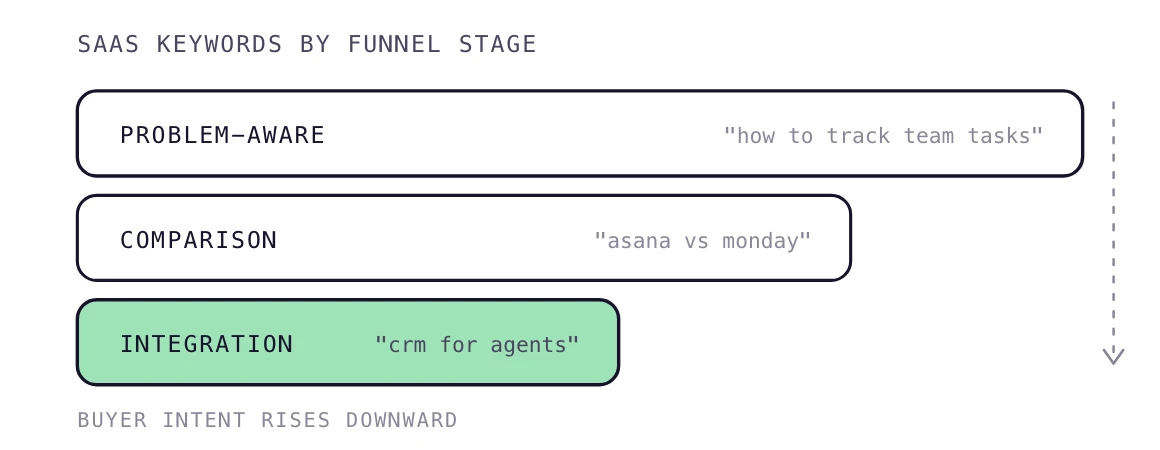
Keyword research for SaaS companies includes identifying the search terms your buyers use at each stage of the funnel. From early problem-aware searches to bottom-funnel comparison and integration terms, then mapping those terms to pages that match buyer intent.
Unlike ecommerce or local SEO, SaaS keyword research has to account for long sales cycles, multiple stakeholders, and category-specific language that rarely surfaces in a generic keyword tool. Get this right, and content becomes a pipeline source instead of a vanity traffic metric.
SaaS keyword research works by mapping search terms to three funnel stages instead of treating every keyword the same way. Most buyers move through problem awareness, solution comparison, and product evaluation, and each phase uses a different language.
A keyword list built around your product name alone misses most of that journey. SaaS keywords need grouping by funnel stage before any content gets written, or you end up with top-of-funnel posts and nothing that closes a deal.
Keyword research shapes SaaS growth because it decides which buyers find you before a sales conversation starts. 67% of B2B buyers now prefer a rep-free buying experience, according to a Gartner sales survey (March 2026).
Content that ranks for problem-aware and comparison keywords reaches buyers while they're still forming a shortlist. Miss those terms, and a competitor's page becomes the one that shapes the buyer's opinion instead.
At PilotDeck, this is one of the first checks in every SaaS engagement:
Finding SaaS keywords starts with mapping funnel stages before opening a keyword tool. This five-step process draws from a broader content and keyword methodology used across SaaS engagements:
Most SaaS teams stop at step 2 because that's what keyword tools surface first. The integration and use-case queries in step 3 are where I've seen the fastest wins for early-stage SaaS clients - low competition, high buyer intent, and usually ignored by bigger competitors with bigger keyword budgets. - Alpesh D.
A SaaS content roadmap needs four keyword types, each mapped to a different funnel stage. PilotDeck maps each type to a dedicated page template before a single article gets written.
Long-tail, integration-specific keywords deserve more weight than their search volume suggests. Keywords with fewer than 10 monthly searches make up nearly 93% of Ahrefs' U.S. keyword database (May 2026), and SaaS buyers increasingly search this way once they've narrowed a category.
| Keyword Type | Funnel Stage | Example |
|---|---|---|
| Problem-aware | Top | "how to manage remote team tasks" |
| Category | Top-Mid | "project management software" |
| Comparison | Mid-Bottom | "Asana vs Monday.com" |
| Integration or role-based | Bottom | "CRM for solo real estate agents" |
Don't build your roadmap around category keywords alone. They carry the highest search volume and the highest competition, and a new SaaS domain rarely outranks established players there without comparison and integration content first. Earn traction with the lower-competition terms, then use that authority to go after category keywords later.
Ahrefs, Google Search Console, and AI visibility trackers each cover a different part of SaaS keyword research.
No single tool covers all three. Most SaaS teams pair a keyword research platform with Search Console data and, increasingly, an AI citation tracker to see where they show up outside classic search. Reviewing all three sources together, instead of picking one, is what turns a keyword list into an actual roadmap.
SaaS keyword research keeps evolving as buyers split their research between Google and AI platforms. Teams that treat both as one continuous discovery process build pipelines that compound over time. Treating them as two separate channels resets progress every quarter instead of building on it.
Map buyer search behavior across three funnel stages. Problem-aware, comparison, and product evaluation, then group keywords into clusters using a tool like Ahrefs or Search Console. Prioritize by intent match, not raw volume. A low-volume term with clear buying intent is usually worth more than a high-volume term that's purely informational.
Target a mix of problem-aware, category, comparison, and integration or role-based keywords. Comparison and integration terms usually convert better despite lower search volume because they signal an active buying decision. Category keywords still matter, but they take longer to rank for.
It determines whether your product shows up while buyers are still forming their shortlist. Most B2B buyers now prefer researching independently, so content has to do work a sales rep used to do. Skip this step, and competitors capture the buyers you never see.
Start with your product name and category, then expand into competitor gap analysis, integration searches, and Google Search Console's existing impression data for queries you already rank for but haven't targeted directly. Forums and review sites like G2 are also useful for the exact phrases buyers use.
A good strategy clusters keywords by funnel stage, prioritizes buyer intent over volume, and builds comparison and integration content early. Not just targets top-of-funnel blog posts. It also gets revisited quarterly as competitors and search behavior shift.
Ahrefs and Semrush remain the standard for volume and competitor gap data. Google Search Console reveals which queries you already rank for but haven't built dedicated pages around, and AI visibility trackers show whether you're being cited in AI-generated answers.

Learn what conversion optimization consulting covers, real benchmarks by traffic stage, and whether your conversion rate or your traffic is the actual problem.
Read →75 sourced statistics on how fast generative AI is spreading, what it costs, who uses it at work, and whether people trust it, with every figure labeled and linked to its source.
Read →
See what b2b seo services actually include, tools vs agencies vs hybrid, plus a month by month checklist, read on to find the right fit for your budget.
Read →Hand over a domain. Research runs and your first article is written within the hour.
Start free trialCancel any month. Your site and content stay yours.