SaaS SEO Services: What They Include, When You Need Them, and How to Choose
See what SaaS SEO services actually include, when DIY and AI tools stop working, and how to evaluate an agency, read on before you hire one.
Read →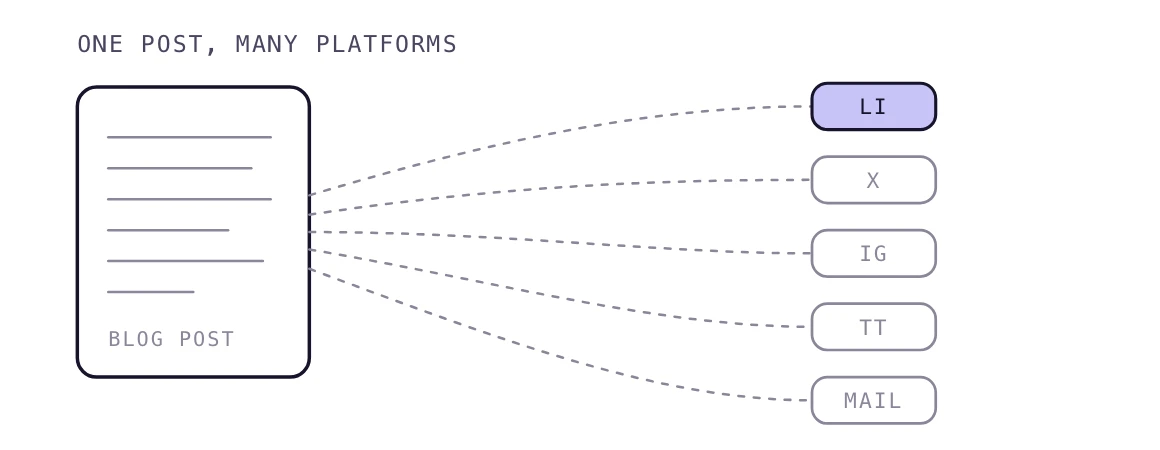
Repurposing a blog post for social media means breaking one article into platform-specific formats without rewriting the research from scratch. A 1,500-word blog post can easily become a LinkedIn carousel, three X posts, a Reel script, and five standalone captions, all pulled from research the team has already done.
Most teams write a post, publish it, share the link once, and move on. That single share captures a fraction of the value sitting inside the original research. The sections below cover exactly how to extract that value, how many posts one article can realistically produce, and which platforms reward the effort most.
This matters more in 2026 than it did a few years ago. Feeds are crowded, attention spans per post are short, and writing time per article has not gotten cheaper even with AI drafting tools in the mix. Getting six or more usable posts out of one round of research changes the math on whether a blog program pays for itself.
Pull the post's strongest ideas first, then rebuild each one for a specific platform. Five steps cover most repurposing workflows.
A tool built to flag high-attention sections speeds up step one considerably, because the extraction work is already half done before a person opens the draft.
A LinkedIn post copied word-for-word from a blog reads like a press release, and a caption written for Instagram usually loses its point when it lands on X without editing. Tone adaptation takes minutes per platform once the core ideas are already extracted.
One post can generate at least six distinct formats, each suited to a different platform and reading habit.
The mapping below is not fixed. A blog post heavy on original data leans toward quote graphics and threads, while a step-by-step tutorial leans toward carousels and video scripts. The goal is matching the format to the strongest part of the article, not forcing every post into every format.
| Blog Element | Social Format | Best Platform |
|---|---|---|
| Key statistic | Quote graphic | Instagram, X |
| Step-by-step section | Carousel | LinkedIn, Instagram |
| Expert opinion | Text post | |
| Contrarian point | Thread | X |
| Full walkthrough | Short video script | TikTok, Reels |
| Summary paragraph | Newsletter teaser | Email, LinkedIn |
This works because PilotDeck treats each subheading as a standalone caption during the drafting stage, so the repurposing list already exists by the time the post publishes.
A 1,500-word post typically yields 8–12 social posts: one core post per platform, plus 3–4 supporting posts spread across the following week.
The average blog post now takes 3 hours and 25 minutes to write, down from a 2022 peak of over four hours, according to Orbit Media's Annual Blogger Survey (August 2025). Spreading that same post across 8–12 social assets stretches the return on that writing time over a full week instead of one publish date.
A useful way to plan the split: one post per major platform on day one, then 2–3 supporting posts per platform on days two through five, drawn from different sections of the same article. Posts scheduled later in the week can reuse a stat or quote that did not make the first cut.
LinkedIn and Instagram absorb the widest range of repurposed formats, while X and TikTok reward shorter, punchier cuts of the same material.
Picking every platform is rarely the right call for a small team. Two platforms done consistently beat five platforms done occasionally, and the cadence column below assumes the post is one of several sources feeding that schedule, not the only one.
| Platform | Best Repurposed Format | Posting Cadence |
|---|---|---|
| Text post, carousel | 2–3x per week | |
| X | Thread, quote card | 3–5x per week |
| Carousel, Reel | 2–3x per week | |
| TikTok | Short video script | 1–2x per week |
Repurpose the section of the post with the highest time-on-page first. Analytics tools flag which paragraph held attention longest, and that paragraph usually makes the strongest social hook.
Publishing tools built for multi-platform scheduling keep this cadence consistent without a separate calendar for every channel.
Yes. AI tools can draft first-pass captions, carousel copy, and video scripts from a blog post within minutes, though the final edit still needs a human voice.
94% of social media marketers now use AI somewhere in their workflow, and repurposing existing material is the highest-leverage tactic available to a small team, according to HubSpot's 2026 Social Media Marketing Report (May 2026).
"AI can turn one blog post into a week of drafts in minutes. The work left for a person is deciding which draft actually sounds like the brand."
PilotDeck runs a version of this draft-then-edit process automatically, generating platform drafts from a published article before a human reviews each one.
A caption that reads like every other AI-generated caption gets scrolled past. Editing for a specific brand voice before publishing is the step that keeps repurposed content from blending into the feed.
The most common mistake is posting the same caption everywhere instead of adapting tone, length, and format to each platform.
This usually happens because repurposing gets treated as an afterthought, squeezed in after the blog post is already live instead of planned alongside it. Teams that block time for repurposing before the post publishes consistently produce more varied, better-targeted posts than teams that repurpose reactively.
Publishing every repurposed post on launch day buries your own content in your own feed. Spread the posts across 5–7 days instead.
PilotDeck's own case study on organic growth breaks down how spacing repurposed content across a week changed traffic without adding headcount.
One blog post, handled this way, becomes a week of social content instead of a single link share. The steps above turn research the team already paid for into six or more platform-native formats. Teams that spread repurposed posts across several days consistently get more mileage from each article than teams that publish once and move to the next draft.
The next post published is a good place to test this. Pick the two strongest sections, match each to a platform, and measure whether the repurposed posts outperform the original link share on its own.
Extract the 3–5 strongest ideas from the post, match each one to a platform, and adapt the tone and format before publishing. Spread the resulting posts across a week rather than all at once.
Break the post into its component parts. Statistics, quotes, steps, and takeaways, then rebuild each part as a caption, carousel, or short video script suited to the platform it's going on.
A single post can produce quote graphics, carousels, text posts, threads, video scripts, and newsletter teasers, depending on which sections of the original article carry the strongest hooks.
Most 1,500-word posts yield 8–12 social posts when split across platforms and spread over roughly a week.
Adapt tone and format per platform, lead with the section that already performed best on the blog, and space posts out instead of publishing everything on launch day.
LinkedIn and Instagram typically absorb the widest range of repurposed formats. X and TikTok work best with shorter, punchier cuts of the same material.
See what SaaS SEO services actually include, when DIY and AI tools stop working, and how to evaluate an agency, read on before you hire one.
Read →
Learn what conversion optimization consulting covers, real benchmarks by traffic stage, and whether your conversion rate or your traffic is the actual problem.
Read →75 sourced statistics on how fast generative AI is spreading, what it costs, who uses it at work, and whether people trust it, with every figure labeled and linked to its source.
Read →Hand over a domain. Research runs and your first article is written within the hour.
Start free trialCancel any month. Your site and content stay yours.