Digital Marketing Agencies for Startups: How to Choose the Right Partner
Compare digital marketing agencies for startups, SEO-only vendors, and AI-native visibility partners to decide what fits your launch stage.
Read →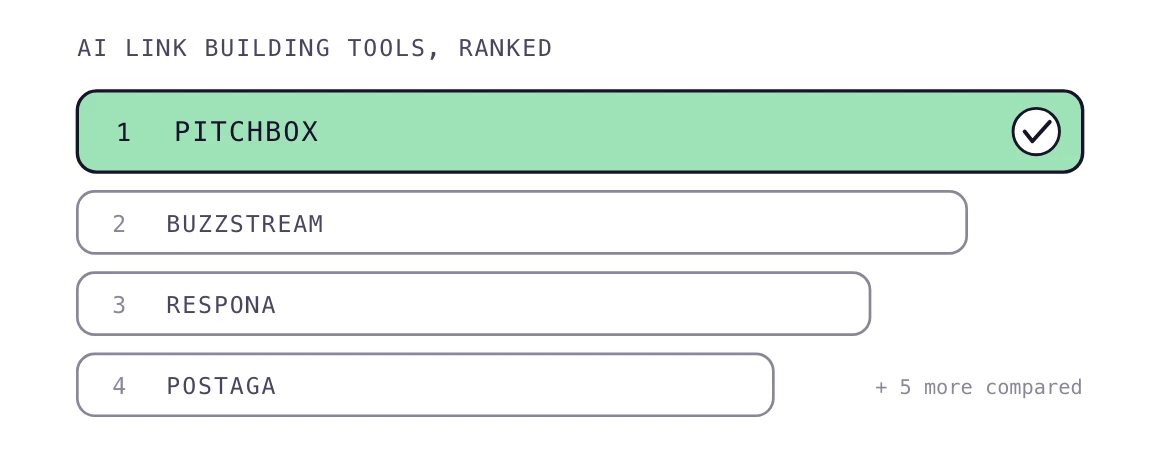
AI link building tools automate the most time-consuming parts of acquiring backlinks, including finding relevant prospects, researching websites, personalizing outreach, and managing follow-ups. The best tool depends on what you need: Pitchbox and BuzzStream are strong for outreach, Ahrefs and Semrush are better for backlink research and competitor gaps, while Postaga, Respona, and Snov.io offer deeper automation. For most teams, AI works best as a research and outreach assistant, with humans still reviewing prospects and pitches before they go out.
Link building isn't going anywhere in 2026. If anything, it's getting more budget. That's the part worth sitting with: budgets are going up because the tools are getting better, not despite it.
Teams aren't replacing outreach with AI, they're using AI to do more outreach, faster, without burning out their team on cold emails and spreadsheets. A recent survey of 500 SEO professionals found that 58% increased their link-building spend this year, even as more of the workflow gets handed off to AI. Reporter Outreach's 2026 State of Link Building survey
That shift is exactly why there are now a dozen-plus tools all claiming to be the smartest way to build links, from full agency platforms to scrappy AI-first upstarts. Some are built for volume, some for relationships, some barely have a paper trail yet. Below is a rundown of where each one actually fits.
AI speeds up three stages of link building. Things like finding relevant sites, writing outreach that sounds human, and tracking replies.
AI tools do this by scanning a prospect's page, extracting topic signals, and ranking sites by relevance before anyone opens an inbox.
Postaga, for example, reads a prospect's page content and drafts a pitch that references it directly, which raises reply rates as compared to generic templates.
Outreach platforms also use AI to follow-up timings.
Tools like Pitchbox and BuzzStream flag stalled threads and suggest the next message, so a campaign does not stall because someone forgot to check a spreadsheet. Teams that also track AI SEO visibility alongside backlinks get an earlier read on which links actually move citations, not just rankings and if they are going after or not.
The table lists ten AI link building tools by core function, so you can scan for a fit before reading the full breakdown. We built this comparison from hands-on testing across agency and in-house workflows.
| Tool | Best For | Key AI Feature |
|---|---|---|
| Pitchbox | Agencies running high-volume campaigns | AI-personalized templates, reply detection |
| BuzzStream | Long-term publisher relationships | Prospect scoring, CRM automation |
| Respona | Teams that want managed, pay-per-link outreach | Fully managed AI outreach campaigns |
| Postaga | Solo SEOs and small teams | Page-read personalization engine |
| Hunter | Budget-conscious contact discovery | Email finding and verification |
| Semrush Link Building Tool | Teams already on Semrush | Prospecting inside existing SEO data |
| Ahrefs | Backlink gap and competitor analysis | AI-assisted Brand Radar mention tracking |
| Snov.io | Multichannel outreach at scale | Sequence automation across email and LinkedIn |
| ProofWrite | Guest post content creation | AI research-first article drafting |
Here's the full breakdown
This is the one you reach for when you're not just running one campaign, you're running twenty of them across different clients at the same time. The prospecting side is stacked, over 20 campaign profiles, deep integrations with Ahrefs, SEMrush, Moz, and Majestic, real-time contact discovery, SERP-based prospecting, the works. Outreach-wise it's got AI personalization, role-based approvals, and a slick site-preview feature so nothing goes out half-baked.
It's genuinely one of the most complete platforms out there. The catch: it's built for scale, so if you're a team of one or two, you'll feel like you're driving a bus to pick up groceries.
if you're managing multiple clients or a high-volume pipeline, this earns its keep. If you're small, it's overkill.
BuzzStream's whole thing is relationships, not volume. It's basically a CRM with outreach bolted on, and that's exactly what makes it good for the "we're building a long-term thing with this publisher" style of link building rather than spray-and-pray campaigns.
It's noticeably cheaper than most of the field, which is honestly a big part of why people still pick it. But next to newer, more AI-forward tools, it starts to feel a little clunky as day-to-day usability lags behind.
solid, budget-friendly, relationship-first. Just don't expect it to feel cutting-edge
If BuzzStream is where most teams start, Respona is where they end up. It's the more polished, more clearly AI-driven option. The personalization feels less like mail-merge and more like it actually reads the page it's pitching. Setup is smoother, the workflow doesn't fight you, and support actually responds when something breaks.
It's easy to use, easy to set up, and quality of support. It's not even close in most categories.
if you've outgrown spreadsheet-and-CRM outreach and want something that feels built for 2026 rather than 2016, this is the one people graduate to.
Postaga is built with small teams and solo operators in mind. It finds opportunities, pulls contact info, and fires off personalized sequences without needing three other tools stitched together. It's not trying to be an enterprise platform, and that's the point.
Its closest rivals are basically Respona and BuzzStream, and it slots in as the lighter-weight option between them, less firepower than Pitchbox, more automation than BuzzStream.
if you're a one-person SEO shop or a lean team who wants something that just works without a learning curve, this is a fair bet.
Hunter doesn't try to be your whole outreach machine, it's laser-focused on finding and verifying email addresses, which honestly is half the battle in link building anyway. Plug in a company or domain, get a verified contact, move on with your day.
What's interesting is Hunter openly says their own link-building isn't a numbers game. About 80% of their links come from actual partnerships, not cold blasts. Says a lot about how they think outreach should work.
pair it with a proper outreach tool if you need one, but for pure contact discovery, it's hard to beat.
This one makes the most sense if you're already living inside Semrush for your SEO work. It leans on Backlink Gap to show you who's linking to your competitors but not you, lets you fire off outreach straight from a connected email account, and tracks whether your links are active, broken, lost, or rejected, all without leaving the platform.
It's not the flashiest tool on this list, but it's convenient, and convenience counts for a lot when you're already knee-deep in Semrush data.
not a standalone reason to switch platforms, but a nice bonus if you're already there.
Ahrefs isn't really an outreach tool, it's a research weapon. With a backlink index north of 35 trillion links and a Content Explorer covering 15.6 billion pages, it's the best place to actually find who's worth pitching in the first place, outdated competitor content, broken pages, sites already linking to people like you.
The trade-off is you'll still need something else to actually send and manage the outreach. Ahrefs finds the "who," it doesn't really do the "send."
the best prospecting brain in the business, paired with literally anything else for execution.
Snov.io isn't built specifically for link building, it's a broader B2B outreach and lead-gen platform Email finding, verification, warm-up, CRM, and multichannel sequencing across email and LinkedIn, can be found all in one place.
It is easily approachable and to get started with. The only downside is that once you've got several campaigns running at once, the dashboard starts to feel a little busy.
good if you want one tool that covers outreach beyond just link building too.
This one's a bit of an odd fit for the list because it's not an outreach tool at all, it's an AI content writer aimed at SEO agencies, affiliate marketers, and editorial teams who need long-form, factually solid content at scale. Think less "send emails," more "write the guest post you're pitching."
It sits in the same lane as tools like Jasper.ai and Surfer SEO rather than anything on this list.
useful if your bottleneck is content creation, not outreach. Just don't expect it to find or contact anyone for you.
AI tools find opportunities by scanning site content, backlink gaps, and topical relevance signals instead of relying on a manually built list. Ahrefs and Semrush take a different angle: both surface backlink gaps against named competitors, showing which domains link to rivals but not to you. Some teams also map these gaps against generative engine optimization signals, since a site that already ranks for a topic in AI answers is often an easier link target too.
Newer tools, including Peek AI, extend this to AI search visibility directly, flagging which articles large language models cite for a topic.
No. AI tools speed up research, drafting, and follow-up, but relationship building and topical judgment still need a person.
Relevance also matters more than volume now: 73.2% of SEO professionals say backlinks affect whether a brand gets cited in AI Search Overviews, according to a 2026 survey of 518 SEO experts (Editorial.link, 2026). A tool that surfaces ten off-topic prospects delivers less value than one that finds three relevant ones.
Full automation without review risks exactly the kind of low-relevance link a manual reviewer would reject on sight.
Treat AI as the research and drafting layer, and keep a person on final review, the same way most teams run PilotDeck's content workflow: AI drafts, a person approves before anything ships.
Pitchbox and BuzzStream are the strongest fits for agencies managing multiple client campaigns, since both scale prospect volume and reporting across accounts.
Respona is worth a look for agencies that want to resell placements without staffing an outreach team directly. Agencies running client reports also benefit from a tool that separates campaigns cleanly, so one client's outreach history never mixes with another's.
Agencies choosing a tool should weigh seat-based pricing against the campaign volume they actually run, and check automated SEO monitoring reports to confirm placements are still live months after they go up.
A five-person agency running eight or more client campaigns gets the most value from Pitchbox's multi-seat reporting. A solo consultant with two or three clients is usually better served by BuzzStream or Postaga.
Pitchbox, BuzzStream, Respona, and Postaga lead for outreach, while Ahrefs and Semrush cover backlink data and prospect discovery.
Ahrefs and Semrush remain the strongest for backlink gap analysis, since both track competitor link profiles alongside your own.
Yes, for research and drafting. Reply rates and placement quality still depend on relevance, so pair AI output with a human review step.
Yes. Postaga and Hunter are priced and scaled for smaller teams, without the multi-seat pricing built for agencies.
Pricing ranges from budget contact-finding tools to agency-tier platforms billed per seat or per campaign. Most vendors publish tiered plans rather than one flat rate.
Yes, when personalization pulls from actual page content instead of a name-and-company template. Generic AI copy performs no better than manual templates.

Compare digital marketing agencies for startups, SEO-only vendors, and AI-native visibility partners to decide what fits your launch stage.
Read →
What a saas content marketing agency does for AI-built sites, how to pick one, and where GEO/AEO fits. A practical buying guide for founders.
Read →
A practical framework for founders choosing an international SEO service: what agencies actually do, what it costs, and a checklist before you sign.
Read →Hand over a domain. Research runs and your first article is written within the hour.
Start free trialCancel any month. Your site and content stay yours.