Digital Marketing Agencies for Startups: How to Choose the Right Partner
Compare digital marketing agencies for startups, SEO-only vendors, and AI-native visibility partners to decide what fits your launch stage.
Read →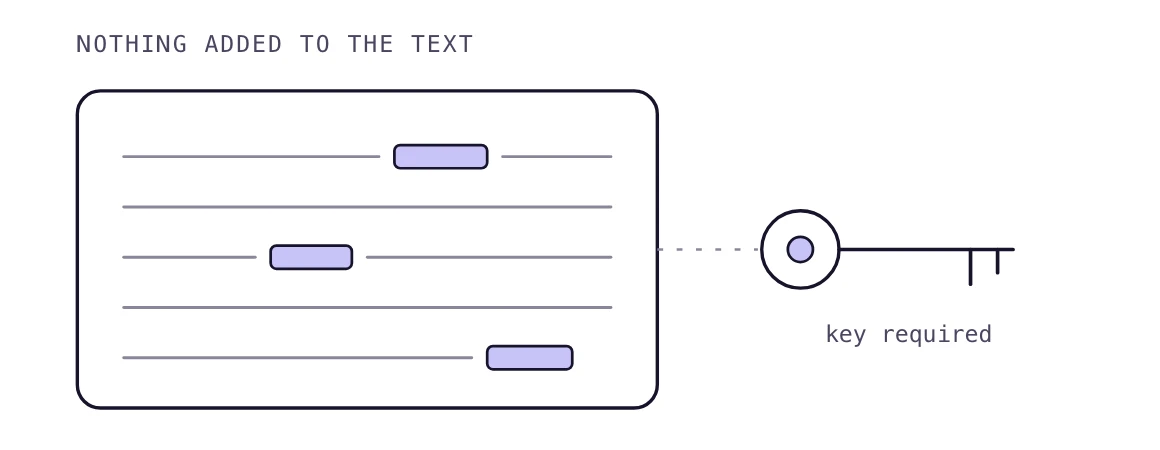
The Claude AI watermark is an invisible statistical pattern that Anthropic embeds in text generated by Claude. Contrary to the popular opinion, Claude adds no hidden characters, symbols, or metadata to your writing. Instead, it changes the source of randomness Claude uses when picking between equally good word options.
Anyone holding Anthropic's key can then measure that pattern and estimate how likely it is that Claude produced the text. Claude models launched on or after August 2, 2026 carry the watermark at the model level, worldwide. Anthropic added it to meet transparency duties under the EU AI Act. A detection API is planned but not public as of August 2026.
Claude AI watermark: a generative text watermark that turns Claude's low-stakes word choices into a machine-readable statistical pattern. Readers cannot see it. Detection requires Anthropic's watermarking key, and that too can only be proven confidently that AI has written the content the longer the content is.
The Claude AI watermark is a statistical signal created through Claude's word choices. It allows a detector with Anthropic's key to estimate whether Claude was involved in generating a piece of text, without adding anything visible or hidden to the text itself.
Anthropic uses different provenance methods for different types of output. Text gets a statistical watermark, while supported files such as PNG, JPG, and SVG receive cryptographically signed C2PA content credentials in their metadata.
Claude's watermark works by changing where the model's randomness comes from. When several words fit a sentence equally well, Claude normally settles the tie with a random number.
From now on, Claude’s generated text will carry a statistical watermark to comply with the EU’s AI transparency rules. The watermark isn’t something you can see or copy out of the text. Instead, Claude uses a secret key along with the few words that came before to influence which plausible word it picks next. That creates a pattern that can be checked later. Anyone with the right key can analyze the finished text and estimate how likely it is that Claude was involved in generating it.
No. Claude's text watermark adds nothing at all to the text: no hidden Unicode characters, no zero-width spaces, no invisible tags, and no extra tokens.
Files behave differently. When Claude produces a .png, .jpg, or .svg, it attaches C2PA provenance metadata, which is why AI-generated image files can lose their mark during format conversion or a screenshot.
"The hidden-character rumor spread faster than the facts. I watched teams run find-and-replace scripts against characters that were never there. Stripping whitespace does nothing here, because the signal lives in which words got picked. You cannot grep for a probability distribution." — Alpesh D., Co-founder, PilotDeck
Claude models launched on or after August 2, 2026 support marking at launch. The marking applies worldwide, not only to users inside the European Union.
Coverage spans the Claude Platform API, Claude, Claude Code, Claude Cowork, and Claude Tag, according to Anthropic's content marking documentation (August 2026). Older models are still being updated during the EU transition period.
Yes, but only with Anthropic's key. A detector scores the text against that key and returns a probability that Claude was involved somewhere in its creation.
That is a different measurement from conventional AI-writing detectors and AI visibility tools, which read stylistic tells rather than a cryptographic key. Anthropic has announced a watermark detection API but has not released it as of August 2026.
Watermark vs. file metadata vs. AI detectors
| Attribute | Claude text watermark | C2PA file metadata | AI writing detectors |
|---|---|---|---|
| What it marks | Generated text | Files (.png, .jpg, .svg) | Any text, after the fact |
| How it is applied | Word-choice pattern | Signed note in metadata | Nothing is applied |
| Survives copy and paste | Yes | No | Not applicable |
| Needs Anthropic's key | Yes | No | No |
| What a hit indicates | Claude likely involved | File processed by Claude | Statistical style guess |
| Public availability | API announced, not released | C2PA readers available | Widely available |
Copying and pasting keeps the watermark, because the mark is the text itself. Light editing still leaves traces of the watermark and is still detectable.
A complete rewrite that replaces every word removes the underlying pattern. Editorial teams at PilotDeck therefore assume a draft stays marked after normal line edits and proofreading passes.
A Claude translation carries a full watermark, because Claude chooses every single word. Heavy paraphrasing does weaken the signal. But Anthropic notes that once every word has changed, whether the text still counts as AI-generated becomes a separate question.
No. The watermark identifies Claude, and does not trace back to the person, team, or account that wrote the prompt.
Anthropic states that neither the mark nor its key can recover user, organization, or chat details.
Anthropic says output quality is unaffected, and the published research supports that position. The method only picks between options the model already considered.
A live test across roughly 20 million Gemini responses found no statistically significant difference in user ratings, according to the SynthID-Text study in Nature (October 2024).
However, critics argue that constraining randomness must reduce variety, and make the content more caricaturish and that debate remains unresolved.
In that same study, thumbs-up rates between watermarked and unwatermarked models differed by 0.01%, and thumbs-down rates by 0.02%. Both sat inside the 95% confidence interval. Added latency measured 0.57% per token on the tested configuration.
Anthropic is complying with the EU AI Act. It signed the EU Code of Practice on Transparency of AI-Generated Content in July 2026, alongside roughly 190 other signatories.
The wider goal is content provenance. For publishers running generative engine optimization, AI involvement becomes a checkable property of a page rather than an accusation based on style.
"Watermarking does not change what good content is. It changes who can prove how content was made. That is a governance question for publishers, not a writing question — and the teams treating it as an editorial policy problem will be the ones who stay out of trouble." — Alpesh D., Co-founder, PilotDeck
Not evenly. The watermark needs choices between equally good words, so factual passages and exact answers carry far less of it. Very short replies may hold too little signal to detect at all. The longer the content is, the more room to detect if Claude was involved or not.
Yes, at the model level. But code that has to be exact leaves little room for the mark, so it lands mainly in comments and surrounding free text. The effect on working code is negligible.
Yes. Marking applies to supported models on the Claude Platform API. It also applies when those models are accessed through AWS, Google Cloud, or Microsoft Foundry.
No. Third-party detectors do not hold Anthropic's key, so they guess from style patterns instead. A watermark check and a detector score measure two different things.
No. Anthropic says the method produces no extra tokens, so serving prices are unchanged. The speed impact is negligible in production.
Yes. Claude picks every word in a translation, so translated output carries a full watermark rather than a partial one.
The watermark is now a fixed property of Claude output, not an optional setting a user can switch off. The next real shift arrives when the detection API ships and third parties can run checks at scale.
Publishers who set a disclosure policy now will be ready for that. Those who wait will be answering questions about drafts they have already shipped.
Compare digital marketing agencies for startups, SEO-only vendors, and AI-native visibility partners to decide what fits your launch stage.
Read →
What a saas content marketing agency does for AI-built sites, how to pick one, and where GEO/AEO fits. A practical buying guide for founders.
Read →
A practical framework for founders choosing an international SEO service: what agencies actually do, what it costs, and a checklist before you sign.
Read →Hand over a domain. Research runs and your first article is written within the hour.
Start free trialCancel any month. Your site and content stay yours.