Digital Marketing Agencies for Startups: How to Choose the Right Partner
Compare digital marketing agencies for startups, SEO-only vendors, and AI-native visibility partners to decide what fits your launch stage.
Read →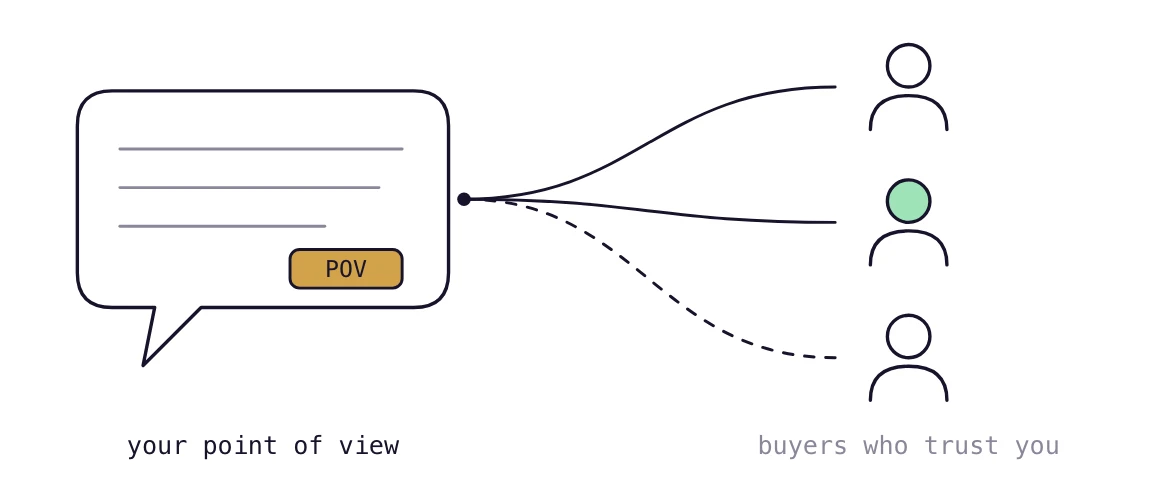
By the PilotDeck Editorial Team - SEO and Content Strategy
Most founders who build a site with a tool like Lovable, v0, Framer, or Bolt hit the same wall a few weeks in: the site looks good, but nobody outside their own network knows it exists. A thought leadership strategy is one of the few reliable ways to fix that without buying ads or chasing backlinks. This guide walks through what it actually is, why it works, and how to build one without turning it into a content treadmill you abandon in month two.
In this article:
A thought leadership strategy is a deliberate plan for sharing your expertise and point of view so that your audience starts to see you (or your company) as a trusted authority in your space, rather than just another vendor. Phoenix.edu describes thought leadership as the practice of establishing credibility and influence by consistently sharing knowledge that helps others solve real problems, and that framing holds up well in practice: Phoenix's overview of what thought leadership is makes clear that it is a positioning exercise first, and a content exercise second.
The strategy part matters because thought leadership without a plan is just occasional opinion-sharing. A real strategy defines who you are trying to reach, what specific angle or belief you are known for, which channels you will show up on consistently, and how you will measure whether any of it is working.
Content marketing is broader and often product-adjacent - blog posts that answer buyer questions, comparison pages, how-to guides. Thought leadership is narrower and opinion-driven. It is less "here is how our product works" and more "here is what we believe about the problem our product exists to solve, and why." The two overlap and reinforce each other, but thought leadership is judged by whether people start quoting you, not just whether they click through.
Thought leadership works because it compounds. A single well-argued post rarely changes anything on its own. What moves the needle is a consistent point of view, repeated across formats and channels, until your name becomes shorthand for a specific idea in your niche.
Every working thought leadership strategy rests on three decisions:
Here is how the common formats compare when you're deciding where to invest first:
| Content Format | Effort to Produce | Typical Reach | Longevity |
|---|---|---|---|
| Long-form articles/blog posts | Medium-High | Medium (compounds via search over time) | High - keeps working for years |
| LinkedIn posts | Low-Medium | High short-term, algorithm-dependent | Low - fades within days |
| Video/podcast appearances | High | Medium-High | Medium - resurfaces via clips and shares |
| Original research or data reports | High | Medium (but high credibility) | High - often cited repeatedly |
> Pro Tip: Long-form articles and original research are the only two formats in that table that keep generating traffic and citations months after publishing. If your time is limited, that's where to spend it first, and use shorter formats like LinkedIn posts to distribute pieces of the bigger work.
For founders whose site was built quickly with an AI tool, this is usually where a structured content funnel strategy helps, because it connects the thought leadership pieces you publish to the searches your actual buyers are running, instead of publishing opinions into a void.
Thought leadership matters because buyers increasingly research who they're buying from before they research what they're buying. If your name or your founder's name shows up consistently with useful, specific insight, you get evaluated on trust before you ever get evaluated on price.
Buyers are more likely to take a chance on a smaller or newer company when the founder has clearly demonstrated they understand the problem deeply. This is especially true for founders who built their product fast with AI tools - the product might be new, but the expertise behind it doesn't have to look new if it's documented consistently.
Unlike a single ad campaign, thought leadership content keeps working. An article that answers a real question your buyers search for can keep bringing in traffic for years, and each new piece adds to a growing body of work that search engines and AI answer engines can both draw on. That's the compounding effect competitor pages on this topic rarely mention: thought leadership isn't just a brand exercise, it's also raw material for organic and AI-driven visibility.
> Key Takeaway: Thought leadership content and SEO content aren't separate efforts. The same well-researched article that builds your authority with human readers is also the content that AI answer engines pull from when someone asks a question in your space - which is why pairing a thought leadership plan with GEO and AEO visibility work gets more out of each piece you publish.
Thought leadership doesn't require a huge following to work. Some of the clearest examples are founders and operators who picked a narrow lane and stuck to it:
At the highest-profile end, public figures like Elon Musk are often cited as examples of thought leadership because of how consistently their public statements shape conversation in their industries - though as with any high-visibility example, it's worth separating the scale of the platform from the mechanics of the strategy, which are the same fundamentals any founder can apply at a smaller scale: pick a lane, say something specific, say it often.
Once the fundamentals are in place, the difference between thought leadership that works and thought leadership that fizzles usually comes down to a handful of practical habits.
Finding your voice and style. Your style is simply how your point of view comes across - direct and data-backed, contrarian and provocative, or calm and explanatory. Pick one that's authentic to how you actually talk, and stay consistent enough that readers recognize your work before they see your name attached to it.
Choosing distribution channels deliberately. Publishing on your own site matters for long-term SEO value, but distribution is what gets the piece in front of people who wouldn't otherwise find it. A simple checklist for each piece you publish:
Measuring impact honestly. Likes and impressions feel good but rarely predict business outcomes. Track direct inquiries that mention a specific piece, search rankings for the topics you're writing about, and - increasingly - whether AI answer tools are citing your content when someone asks a related question. Tools built specifically to track that kind of visibility, like PilotDeck's AI SEO visibility tracking, can show whether your thought leadership content is actually being surfaced in AI-generated answers, not just ranking on a search results page.
Common mistakes to avoid:
Founders who built their site quickly with an AI website builder often make the last mistake by default - they publish a handful of posts, see no immediate traffic, and stop. Thought leadership content works the same way SEO does: it needs a consistent publishing cadence and periodic review, not a single burst of effort. That review process is exactly what a structured content funnel strategy is designed to catch - checking each month what's ranking, what's getting cited, and what needs to change before doubling down further.
Two trends stand out heading into 2026. First, AI-generated answer engines (the systems behind AEO and GEO) are increasingly the place people go for quick answers, which means thought leadership content needs to be written clearly enough to be quoted directly, not just ranked. Second, distribution is becoming more multi-channel and short-form by default - a single long-form piece is now expected to be repurposed into LinkedIn posts, short video clips, and newsletter snippets rather than published once and left alone.
A thought leadership style is the consistent voice and tone a person or brand uses when sharing their point of view - for example, direct and contrarian, calm and data-driven, or story-based and reflective. The specific style matters less than consistency; readers should be able to recognize your work by how it sounds before they see who wrote it.
Thought leadership theory refers to the underlying idea that influence and trust are built by consistently demonstrating expertise and original thinking, rather than by advertising or self-promotion alone. The theory holds that audiences trust people who teach them something useful over people who simply ask for their attention or business.
By most common definitions, yes - Elon Musk is frequently cited as a thought leader because his public statements consistently shape conversation and expectations across the industries he's involved in, from electric vehicles to space travel. That said, he's an extreme, high-visibility example; the underlying strategy that makes someone a thought leader - a consistent point of view, shared often, in a specific lane - applies at any scale, including for a small business founder writing for a niche audience.
Musk has publicly stated that he has Asperger's syndrome, which is on the autism spectrum. He disclosed this himself in a public setting, and it's worth noting purely because his willingness to speak about it became, in itself, part of his public commentary and visibility - a reminder that thought leadership often includes personal disclosure, not just professional opinion. Beyond that context, personal details like this aren't central to evaluating thought leadership strategy and are outside the scope of what this guide covers.

Compare digital marketing agencies for startups, SEO-only vendors, and AI-native visibility partners to decide what fits your launch stage.
Read →
What a saas content marketing agency does for AI-built sites, how to pick one, and where GEO/AEO fits. A practical buying guide for founders.
Read →
A practical framework for founders choosing an international SEO service: what agencies actually do, what it costs, and a checklist before you sign.
Read →Hand over a domain. Research runs and your first article is written within the hour.
Start free trialCancel any month. Your site and content stay yours.